Within Hyman Review
The First Test Hyman Wanted Run Again
Hyman's most practical demand was simple: let outsiders rejudge the same materials blind and see whether the effect remains.
On this page
- Why rejudging mattered before new experiments
- What blind outside judges would have to see
- How a failed rejudging would change the evidence
Page outline Jump by section
Introduction
Ray Hyman’s first recommendation after reviewing the U.S. government’s remote-viewing research was notably practical rather than theoretical. Before launching new experiments or debating paranormal explanations, he argued that the existing Science Applications International Corporation (SAIC) studies should be rejudged by independent people who were blind to the correct answers. If the reported effects survived that test, confidence in the findings would increase. If they did not, the apparent success might have reflected the original judging process rather than genuine remote viewing. This proposal became one of the clearest methodological dividing lines in the debate because it focused on whether the evidence could withstand independent scrutiny instead of relying on the original research team’s own assessments.[National Security Archive]nsarchive2.gwu.eduNational Security ArchiveAn Evaluation of Remote Viewing: Research and…March 13, 2015 — by MD Mumford · 1995 · Cited by 76 — Both Prof…
Why rejudging mattered before new experiments
Hyman’s proposal reflected a common principle in experimental science: before investing in further research, first establish that the existing evidence is not dependent on a particular analyst, scoring method or laboratory practice. In free-response remote-viewing experiments, participants typically produce sketches and descriptive impressions rather than simple yes-or-no answers. Someone must then compare those descriptions with possible targets and decide which is the closest match.
That evaluation stage introduces human judgement. Even when judges work honestly, subtle expectations, familiarity with the experimental materials or unconscious preferences can influence rankings. Hyman therefore argued that an independent re-analysis of exactly the same sessions would be a more direct way to test whether the reported success reflected information in the viewers’ descriptions or features of the original judging process.[National Security Archive]nsarchive2.gwu.eduNational Security ArchiveAn Evaluation of Remote Viewing: Research and…March 13, 2015 — by MD Mumford · 1995 · Cited by 76 — Both Prof…
Importantly, this was not a demand to discard the SAIC data. It was an attempt to determine whether the evidence was robust enough to survive a change in who performed the scoring.
What blind outside judges would have to see
The AIR review records an unusual point of agreement between Hyman and statistician Jessica Utts, who otherwise reached very different conclusions about the evidence. Both agreed that the first step should be to have the SAIC protocols “rejudged by independent judges who are blind to the actual target.”[National Security Archive]nsarchive2.gwu.eduNational Security ArchiveAn Evaluation of Remote Viewing: Research and…March 13, 2015 — by MD Mumford · 1995 · Cited by 76 — Both Prof…
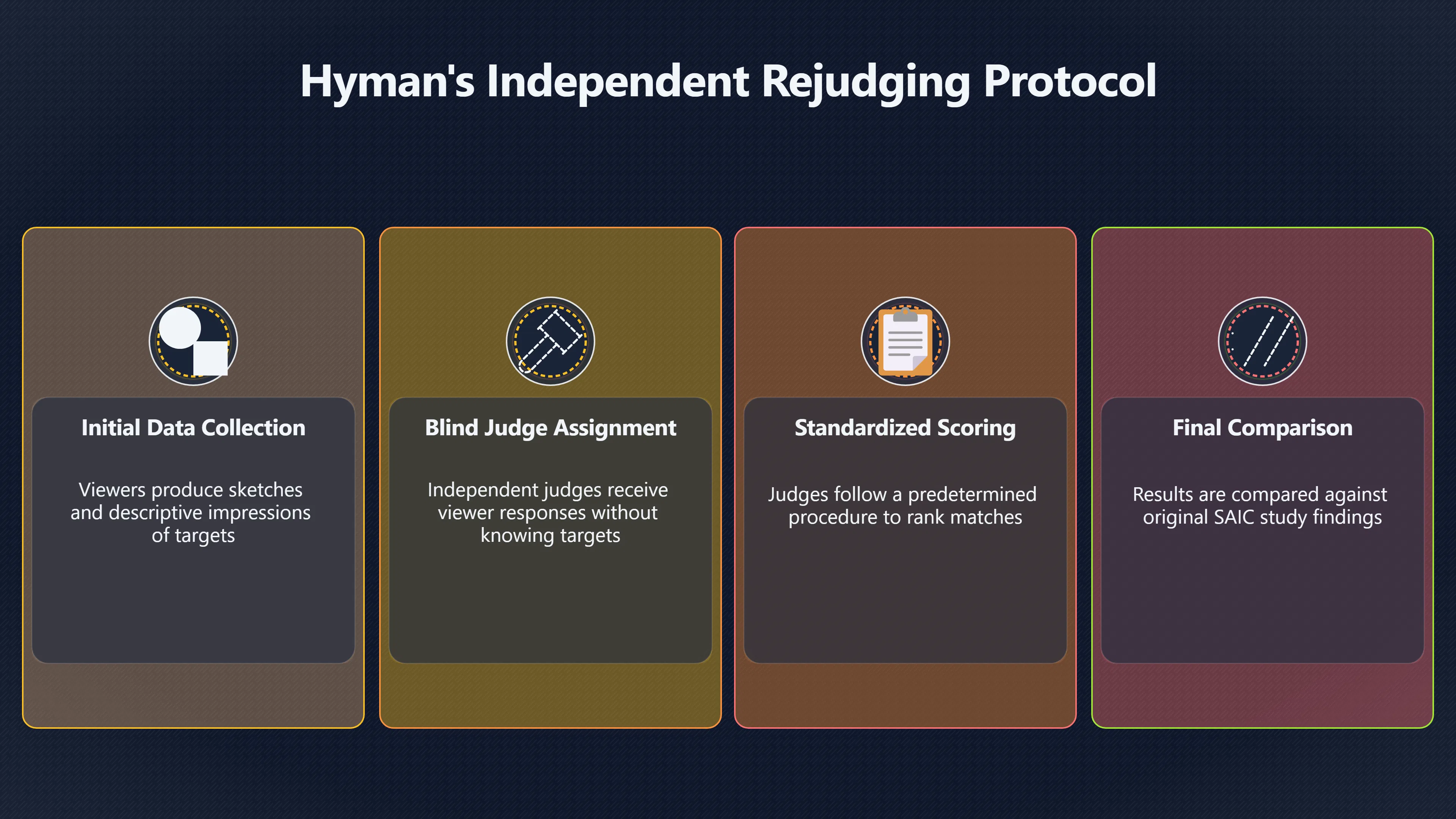
In practical terms, such a test would require judges who:
- had no involvement in the original experiments;
- did not know which target was correct;
- received only the viewer’s response together with the candidate targets;
- followed a predetermined scoring procedure; and
- completed their evaluations without feedback from the original investigators.
The purpose was to remove any possibility that knowledge of the experiment, familiarity with particular sessions or expectations about successful viewers could influence the rankings.
Because the experimental data would remain unchanged, only the judging would differ. That made independent rejudging an efficient diagnostic test. If the effect remained, confidence would increase that the information lay within the descriptions themselves. If the effect weakened substantially, attention would shift towards the judging procedure as a possible source of the original findings.[National Security Archive]nsarchive2.gwu.eduNational Security ArchiveAn Evaluation of Remote Viewing: Research and…March 13, 2015 — by MD Mumford · 1995 · Cited by 76 — Both Prof…
Why judging was a critical vulnerability
Hyman’s emphasis on rejudging reflected a broader concern about free-response experiments. Unlike objective measurements, such as reaction times or multiple-choice answers, remote-viewing transcripts often contain many broad or symbolic descriptions. Matching these to targets inevitably involves interpretation.
This concern was reinforced by earlier controversies surrounding the original Stanford Research Institute experiments. Psychologists David Marks and Richard Kammann argued that judges in some early studies could make accurate matches using ordinary cues embedded in transcripts rather than paranormal information. Their work became a prominent example of how judging procedures themselves could create apparently impressive results if sensory cues or contextual information were not fully eliminated.[Wikipedia]WikipediaRemote viewingRemote viewing
Hyman did not claim that the later SAIC studies necessarily suffered from the same flaws. Instead, he argued that independent blind rejudging offered the most straightforward way to demonstrate that the newer protocols had genuinely solved such problems.
How a failed rejudging would change the evidence
A failed independent rejudging would not automatically prove fraud or misconduct. Instead, it would suggest that the reported statistical effect depended on the original judging system.
That outcome would have several implications:
- The evidence would become less generalisable. Success would appear tied to a specific laboratory procedure rather than to remote viewing itself.
- Alternative explanations would gain credibility. Scoring conventions, subjective interpretation or subtle procedural influences would become stronger candidates than paranormal perception.
- Replication priorities would change. Researchers would first need to identify why different judges reached different conclusions before treating the original findings as evidence for psychic functioning.
Conversely, if independent judges consistently reproduced the original rankings while remaining blind to the correct targets, one important class of methodological criticism would be substantially weakened. It would not by itself establish the existence of remote viewing, but it would show that the reported effect was not merely an artefact of one judging team.[National Security Archive]nsarchive2.gwu.eduNational Security ArchiveAn Evaluation of Remote Viewing: Research and…March 13, 2015 — by MD Mumford · 1995 · Cited by 76 — Both Prof…

The lasting significance of Hyman’s first test
Hyman’s recommendation has remained influential because it illustrates a broader principle of scientific governance: extraordinary claims become more persuasive when they survive evaluation by people who have no stake in the original result.
His proposal deliberately avoided debates about theories of psychic functioning or statistical significance. Instead, it asked a simpler question: would independent observers, working under blind conditions, reach the same conclusions from the same evidence?
By making independent rejudging his first recommendation, Hyman identified the judging process—not merely the numerical results—as a critical point where confidence in the remote-viewing evidence either would be strengthened or would begin to unravel.[National Security Archive]nsarchive2.gwu.eduNational Security ArchiveAn Evaluation of Remote Viewing: Research and…March 13, 2015 — by MD Mumford · 1995 · Cited by 76 — Both Prof…
Amazon book picks
Further Reading
Books and field guides related to The First Test Hyman Wanted Run Again. Use these as the next step if you want deeper reading beyond the article.
Statistics Done Wrong
Relevant to independent reanalysis and methodological criticism.

Remote Viewers: The Secret History of America's Psychic Spies
Provides context for Hyman's review and later debate.

eBay marketplace picks
Marketplace Samples
Live-tested eBay searches with available results related to this page.
Endnotes
1.
Source: nsarchive2.gwu.edu
Link:https://nsarchive2.gwu.edu/NSAEBB/NSAEBB438/docs/doc_57.pdf
Source snippet
National Security ArchiveAn Evaluation of Remote Viewing: Research and...March 13, 2015 — by MD Mumford · 1995 · Cited by 76 — Both Prof...
Published: March 13, 2015
2.
Source: Wikipedia
Title: Remote viewing
Link:https://en.wikipedia.org/wiki/Remote_viewing
Additional References
3.
Source: cia.gov
Link:https://www.cia.gov/readingroom/docs/CIA-RDP96-00791R000200180005-5.pdf
Source snippet
AN EVALUATION OF THE REMOTE VIEWING PROGRAMHyman's opinions on areas of agreement and disagreement are included in his report; in additio...
4.
Source: cia.gov
Link:https://www.cia.gov/readingroom/docs/CIA-RDP96-00791R000200180006-4.pdf
Source snippet
AN EVALUATION OF REMOTE VIEWINGDr. Hyman. A judge then examines the viewer's report and determines if this report matches the target or...
5.
Source: newdualism.org
Link:https://www.newdualism.org/papers/D.Stokes/Experimental_Psi.html
Source snippet
4. The Evidence for Psi: Experimental StudiesOther examples of free-response experiments include remote viewing studies, in which a subje...
6.
Source: researchgate.net
Link:https://www.researchgate.net/publication/333228024_An_Assessment_of_the_Evidence_for_Psychic_Functioning
Source snippet
An Assessment of the Evidence for Psychic FunctioningPDF | Research on psychic functioning, conducted over a two-decade period, is examin...
7.
Source: dau.url.edu
Link:https://dau.url.edu/bitstream/handle/20.500.14342/3733/Brain%20and%20Behavior%20-%202023%20-%20Escol%C3%A0%E2%80%90Gasc%C3%B3n%20-%20Follow%E2%80%90up%20on%20the%20U%20S%20%20Central%20Intelligence%20Agency%20s%20%20CIA%20%20remote%20viewing%20%281%29.pdf?isAllowed=y&sequence=1
Source snippet
Central Intelligence Agency's (CIA)...by Á Escolà-Gascón · 2023 · Cited by 10 — Reports on the declassified SRI and [SAIC experiments]({{ 'saic-tests/' | relative_url }}) wer...
8.
Source: ics.uci.edu
Link:https://www.ics.uci.edu/~jutts/hyman.html
Source snippet
of Program on Anomalous Mental PhenomenaHowever, if remote viewing is real, then conscientious judges, who are blind... rejudged by inde...
9.
Source: koestlerunit.wordpress.com
Link:https://koestlerunit.wordpress.com/wp-content/uploads/2015/06/wiseman-milton-1998.pdf
Source snippet
One of the SAIC Remote Viewing Programby R Wiseman · Cited by 24 — The Central Intelligence Agency recently commissioned a report on the...
10.
Source: philpapers.org
Link:https://philpapers.org/archive/BULPEL-2.pdf
Source snippet
HARNESSING INFORMATIONAL FIELDS FOR ENERGY...by M Bulaqueña · 2026 — • Blind judging: Independent judges, who did not know which target...
11.
Source: researchgate.net
Title: 374881423 Remote Viewing A 1974 2022 Systematic Review and [Meta Analysis]({{ ‘meta-analysis/’ | relative_url }})
Link:https://www.researchgate.net/publication/374881423_Remote_Viewing_A_1974-2022_Systematic_Review_and_Meta-Analysis
Source snippet
(PDF) Remote Viewing: A 1974-2022 Systematic Review...26 Oct 2023 — PDF | This is the first meta-analysis of all studies related to remo...
12.
Source: academia.edu
Title: Remote Viewing A 1974 2022 Systematic Review and Meta Analysis
Link:https://www.academia.edu/108445581/Remote_Viewing_A_1974_2022_Systematic_Review_and_Meta_Analysis
Source snippet
Remote Viewing: A 1974- 2022 Systematic Review and...The systematic review covers 36 studies, revealing a decline effect in remote viewi...
Topic Tree