Within Read Files
Was the Target Really Hidden?
Tasking details can reveal whether a viewer was truly blind or whether ordinary clues may have shaped the session.
On this page
- What tasking sheets can disclose
- Background knowledge and ordinary inference
- Questions to ask before trusting a match
Page outline Jump by section
Introduction
When reading declassified remote viewing files, one of the most important questions is not whether a session appears impressive but whether the target was genuinely hidden from the people conducting it. Tasking sheets—the documents that define what the viewer is supposed to describe—often provide the best evidence for answering that question. They can reveal how much information was supplied before the session, who knew the target, whether the monitor may have possessed relevant knowledge, and whether ordinary inference could have influenced the outcome.

This matters because remote viewing claims depend heavily on experimental control. A transcript that seems remarkably accurate becomes much less persuasive if the viewer received background information, if the monitor knew the target in detail, or if the task itself contained subtle clues. Conversely, a carefully documented blind protocol carries greater evidential weight because it reduces opportunities for conventional information transfer. Official programme evaluations repeatedly identified operational tasking and background knowledge as major limitations when interpreting reported successes.[National Security Archive]nsarchive2.gwu.eduNational Security ArchiveAn Evaluation of Remote Viewing: Research and…March 13, 2015 — by MD Mumford · 1995 · Cited by 76 — In the ea…
What tasking sheets can disclose
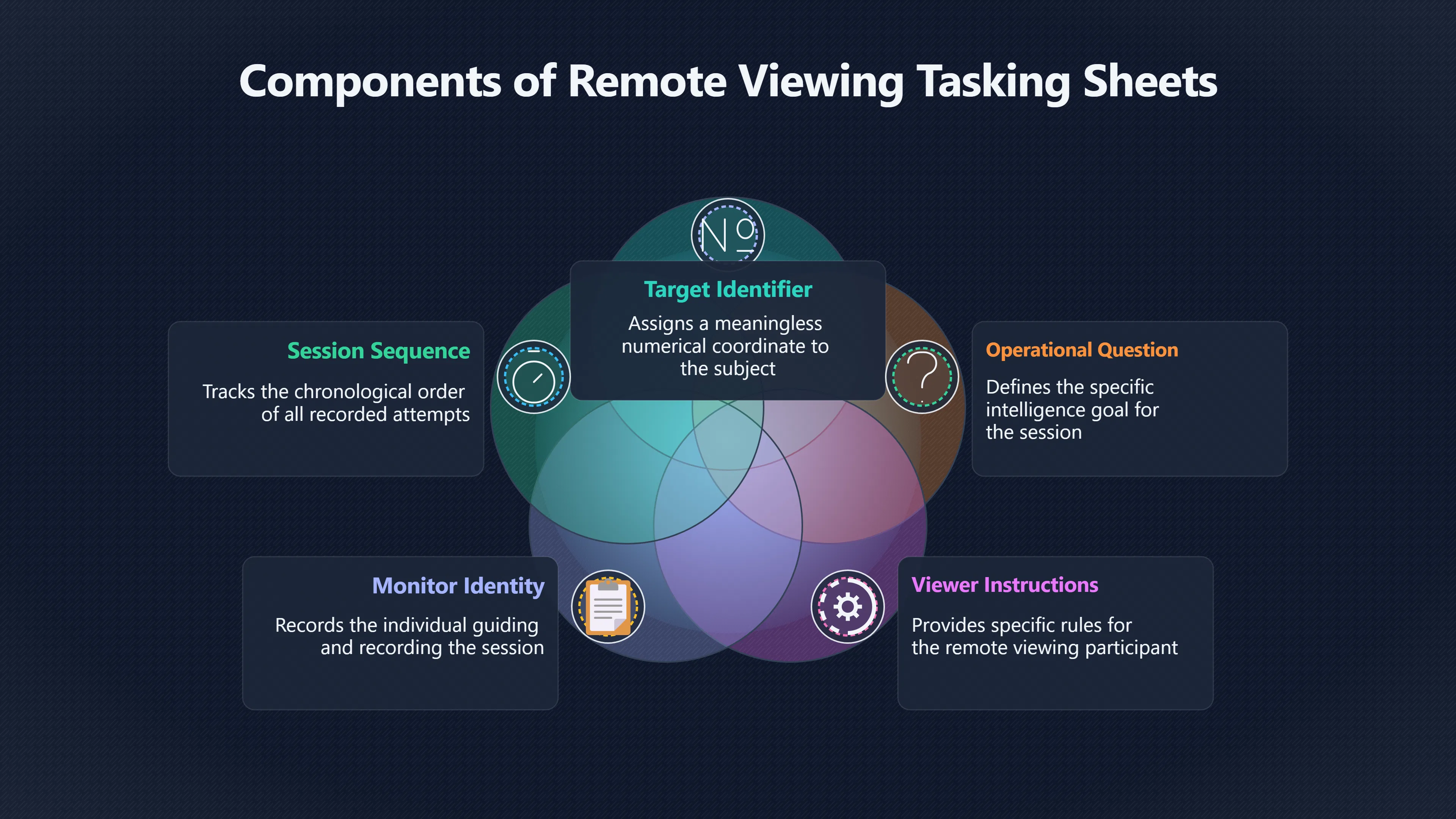
A tasking sheet is more than an administrative form. In many declassified programmes it records the practical circumstances of a session, including:
- the target identifier or coordinate;
- the operational question being asked;
- what instructions were given to the viewer;
- who requested the session;
- the monitor or interviewer;
- the date and sequence of the session; and
- sometimes restrictions on feedback or prior information.
These details help reconstruct whether the session approximated a controlled blind experiment or resembled an intelligence briefing in which participants already possessed partial knowledge.
Some remote viewing protocols attempted to minimise information leakage by assigning meaningless numerical identifiers instead of descriptive target names. The intention was that the viewer would receive only the identifier, while target information remained inaccessible until after the session. However, not every operational document followed equally strict procedures, and declassified records show that practices varied over time and between projects.[CIA]cia.govA SUGGESTED REMOTE VIEWING TRAINING…(U) Remote viewing requires a viewer, a monitor and a target…. UNCLASSIFIED. (U) in particul…
Even apparently trivial wording deserves attention. A task framed as “describe the target” differs from one asking “describe the Soviet submarine facility” or “locate the missing aircraft”. The latter already narrows the range of possibilities and provides a conceptual framework that may influence interpretation before any impressions are recorded.
Background knowledge and ordinary inference
The strongest remote viewing claims assume that neither the viewer nor the monitor could have acquired relevant information through ordinary means. Tasking documentation helps readers test that assumption.
The 1995 American Institutes for Research evaluation found that operational conditions often differed substantially from laboratory experiments. Interview evidence suggested that viewers sometimes possessed at least some background knowledge about the task, and in certain cases substantially more than outside readers might assume. The report also noted concerns that previous programme managers may have altered reports or supplied additional contextual information, making later interpretation difficult.[National Security Archive]nsarchive2.gwu.eduNational Security ArchiveAn Evaluation of Remote Viewing: Research and…March 13, 2015 — by MD Mumford · 1995 · Cited by 76 — In the ea…
Background knowledge need not consist of classified facts to influence a session. It may include:
- awareness of the requesting agency or military operation;
- knowledge of the historical period;
- familiarity with previous sessions involving similar targets;
- information shared during informal discussion before recording began; or
- assumptions suggested by the wording of the assignment.
Each piece of context reduces the amount of genuinely unknown information that must be explained by remote viewing itself.
From a psychological perspective, partial knowledge also makes ordinary inference easier. If someone already knows the target concerns a naval installation during the Cold War, descriptions involving water, metal structures, security or industrial activity become less surprising than if no context were available at all.
The monitor matters as much as the viewer
Readers often concentrate on whether the viewer was blind while overlooking the role of the session monitor.
In many remote viewing procedures, the monitor guided the session by asking follow-up questions, encouraging elaboration or requesting clarification. Even without intending to influence the viewer, a monitor who knows the target may unconsciously provide cues through tone, timing, emphasis or selective follow-up. This possibility is well recognised in psychological research as a source of expectancy effects and experimenter influence.
For that reason, stronger protocols attempted to blind both the viewer and the monitor or to limit what the monitor knew about the target. When a tasking sheet identifies who possessed target knowledge, it gives readers a practical way to judge the strength of the controls rather than assuming they existed.

Questions to ask before trusting a match
When examining a declassified session, a few practical questions can greatly improve interpretation.
Was the viewer genuinely blind? Look for evidence that only a neutral coordinate or identifier was supplied rather than a descriptive task.
What did the monitor know? If the documentation shows the monitor knew the target, consider whether subtle guidance could have affected the session.
How specific was the task? Broad requests generally provide fewer ordinary clues than assignments already identifying a country, organisation, person or type of facility.
Was background information acknowledged? Operational files sometimes indicate that viewers received contextual briefings. Such disclosures should be considered before treating apparent correspondences as extraordinary.
Was the session recorded before feedback? Accurate timing matters. Material added after learning the target should not be treated as independent evidence.
Are impressive details actually specific? General descriptions often appear stronger after readers connect them with known target features. Distinguish between concrete statements that could have been wrong and flexible descriptions that fit many possible locations.
Why tasking clues change how evidence should be weighed
Tasking sheets rarely determine whether a remote viewing claim is true or false. Instead, they determine how much confidence readers should place in any apparent correspondence between transcript and target.
A session that appears striking but lacks documentation about blinding, prior knowledge or monitor awareness cannot easily distinguish extraordinary perception from conventional information pathways. By contrast, a session accompanied by clear tasking records, explicit blinding procedures and documented limits on background knowledge provides a stronger basis for evaluating the claim on its own merits.
This is one reason official reviews of the Star Gate programme placed considerable emphasis on operational conditions rather than on isolated “hits”. The available evidence suggested that intelligence tasking often introduced practical complications—including varying target types, incomplete controls and background knowledge—that made operational successes difficult to interpret as clear demonstrations of remote viewing, regardless of how compelling individual transcripts might appear.[National Security Archive]nsarchive2.gwu.eduNational Security ArchiveAn Evaluation of Remote Viewing: Research and…March 13, 2015 — by MD Mumford · 1995 · Cited by 76 — In the ea…
Amazon book picks
Further Reading
Books and field guides related to Was the Target Really Hidden?. Use these as the next step if you want deeper reading beyond the article.
The Men Who Stare At Goats
Rating: 3.5/5 from 11 Google Books ratings
Explores strange U.S. military attempts to turn psychic and paranormal ideas into operational capability.
Phenomena: The Secret History of the U.S. Government's Invest...
Provides context for operational procedures.

Paranormality: Why We See What Isn't There
Discusses ordinary information leakage and bias.
Endnotes
1.
Source: cia.gov
Link:https://www.cia.gov/readingroom/docs/CIA-RDP96-00791R000200180005-5.pdf
Source snippet
AN EVALUATION OF THE REMOTE VIEWING PROGRAMThe NRC provided a thorough review of the unclassified remote viewing research through 1986...
2.
Source: cia.gov
Link:https://www.cia.gov/readingroom/docs/CIA-RDP96-00789R002200070001-0.pdf
Source snippet
A SUGGESTED REMOTE VIEWING TRAINING...(U) Remote viewing requires a viewer, a monitor and a target.... UNCLASSIFIED. (U) in particul...
3.
Source: nsarchive2.gwu.edu
Link:https://nsarchive2.gwu.edu/NSAEBB/NSAEBB438/docs/doc_57.pdf
Source snippet
National Security ArchiveAn Evaluation of Remote Viewing: Research and...March 13, 2015 — by MD Mumford · 1995 · Cited by 76 — In the ea...
Published: March 13, 2015
Additional References
4.
Source: youtube.com
Link:http://www.youtube.com/watch?v=DsHM8V6D6sk
Source snippet
Remote viewing experimental control and blinding protocols AS2021-10: VISTA Program: Applying Controlled Remote Viewing to Afterlife Rese...
5.
Source: reddit.com
Link:https://www.reddit.com/r/consciousness/comments/181s71r/the_cias_experiments_with_remote_viewing_and/
Source snippet
perimentation with Ingo Swann can provide some evidence toward “non-local...Read more...
6.
Source: academia.edu
Title: (PDF) The Star Gate Operational Remote Viewing Program
Link:https://www.academia.edu/95285973/The_Star_Gate_Operational_Remote_Viewing_Program_A_Human_Intelligence_HUMINT_Collection_Platform
Source snippet
declassified documents, including a systematic review of the operational remote viewing projects.... Time Period: 1980 Task Originator...
7.
Source: facebook.com
Link:https://www.facebook.com/100090372200308/posts/during-the-cold-war-the-cia-funded-research-into-what-they-called-remote-viewing/937678002587931/
Source snippet
During the Cold War, the CIA funded research into what...The final AIR report concluded that no remote viewing report ever provided acti...
8.
Source: youtube.com
Title: Remote Viewing Applications Survey | Debra Lynne Katz
Link:http://www.youtube.com/watch?v=9O8YL5cfh1I
Source snippet
AS2021-10: VISTA Program: Applying Controlled Remote Viewing to Afterlife Research - Mark Boccuzzi...
9.
Source: pmc.ncbi.nlm.nih.gov
Link:https://pmc.ncbi.nlm.nih.gov/articles/PMC10275521/
Source snippet
Central Intelligence Agency's (CIA...by Á Escolà‐Gascón · 2023 · Cited by 10 — Since 1972, the U.S. Central Intelligence Agency (CIA) co...
10.
Source: youtube.com
Title: Remote Viewing Training, Part One: The Initial Phases, with Paul H. Smith
Link:http://www.youtube.com/watch?v=Y2Ryc196s0I
Source snippet
Remote Viewing Applications Survey | Debra Lynne Katz...
11.
Source: youtube.com
Title: Learn How To Remote View In Less Than 20 Minutes!
Link:http://www.youtube.com/watch?v=Thq8sVv0lps
Source snippet
Remote Viewing Training, Part One: The Initial Phases, with Paul H. Smith...
12.
Source: ciaotest.cc.columbia.edu
Title: sa jan02srm01
Link:https://ciaotest.cc.columbia.edu/olj/sa/sa_jan02srm01.html
Source snippet
Remote Viewing: The US Sponsored Psychic...This paper deals with experiments conducted in USA in which certain individuals were trained...
13.
Source: youtube.com
Title: How To Do a Simple Remote Viewing
Link:http://www.youtube.com/watch?v=BIE2BClEok0
Source snippet
Learn How To Remote View In Less Than 20 Minutes...
Topic Tree