Within Remote Viewing
The Later Tests Behind the 1995 Debate
Later SAIC work kept the laboratory debate alive after the original SRI experiments became controversial.
On this page
- Why SAIC Mattered
- Laboratory Design Issues
- How Reviewers Interpreted Results
Page outline Jump by section
Introduction
The SAIC phase of U.S. remote-viewing research matters because it was the programme’s late laboratory test case: cleaner, more statistically explicit, and more directly tied to the 1995 evaluation that helped end government support. Science Applications International Corporation inherited the later contractor research after the earlier Stanford Research Institute work had become controversial, and its experiments from 1992 to 1994 became the main evidence base reviewed by statistician Jessica Utts and psychologist Ray Hyman. Both agreed that the laboratory results showed a statistically significant effect. They disagreed sharply over what that meant. Utts argued that the evidence supported anomalous cognition; Hyman argued that statistical significance did not establish a paranormal cause, especially when the same viewers, judge, target sets and scoring methods recurred across the most important studies. The SAIC work therefore kept the debate alive while also revealing why a laboratory anomaly did not translate into accepted science or dependable intelligence use.[National Security Archive]nsarchive2.gwu.eduNational Security Archiveremote~1.PD FNational Security Archiveremote~1.PD F
Why SAIC Mattered
SAIC mattered less because it began remote viewing and more because it became the late-stage test of whether remote viewing could survive stricter criticism. Earlier SRI experiments had attracted attention and funding, but reviewers had also identified familiar weaknesses: sensory cueing, ambiguous judging, statistical dependence and loose controls. By the time the CIA asked the American Institutes for Research to evaluate the programme in 1995, the question was not simply whether anyone had once produced an impressive description. The question was whether the newer research, especially the SAIC studies, contained evidence strong enough to justify further scientific or intelligence investment.[National Security Archive]nsarchive2.gwu.eduNational Security Archiveremote~1.PD FNational Security Archiveremote~1.PD F
The AIR review was set up to handle controversy rather than ignore it. Utts and Hyman were asked to examine the programme documents and prepare independent reviews, covering whether a statistically significant effect existed, whether any effect could be attributed to a paranormal phenomenon, what mechanisms or boundary conditions might explain it, and what the findings implied for possible applications.[National Security Archive]nsarchive2.gwu.eduNational Security Archiveremote~1.PD FNational Security Archiveremote~1.PD F
That structure made SAIC central. Hyman later described the reviewed work as covering SRI from 1973 to 1989 and SAIC from 1992 to 1994, with attention focused on the ten most recent SAIC experiments because they were both recent and methodologically stronger than much of the older work.[ResearchGate]researchgate.net267978941 Evaluation of Program on 'Anomalous Mental PhenomenaEvaluation of Program on 'Anomalous Mental Phenomena'January 1, 1995 — We focussed on the ten most recent experiments which w… Utts likewise noted that Edwin May listed ten SAIC experiments in a July 1995 memorandum, designed not merely to add another “proof” trial but to investigate specific questions raised by earlier SRI and parapsychology research.[UC Irvine Bren School]ics.uci.eduUC Irvine Bren Schoolics.uci.eduUC Irvine Bren Schoolics.uci.edu
This is why the SAIC phase has an unusual place in remote-viewing history. It is not just an appendix to the older Cold War story. It is the evidence set that forced reviewers to say, in effect: the experimenters had improved the controls, the statistics were not trivial, but the interpretation remained unresolved.
What the Later Tests Tried to Measure
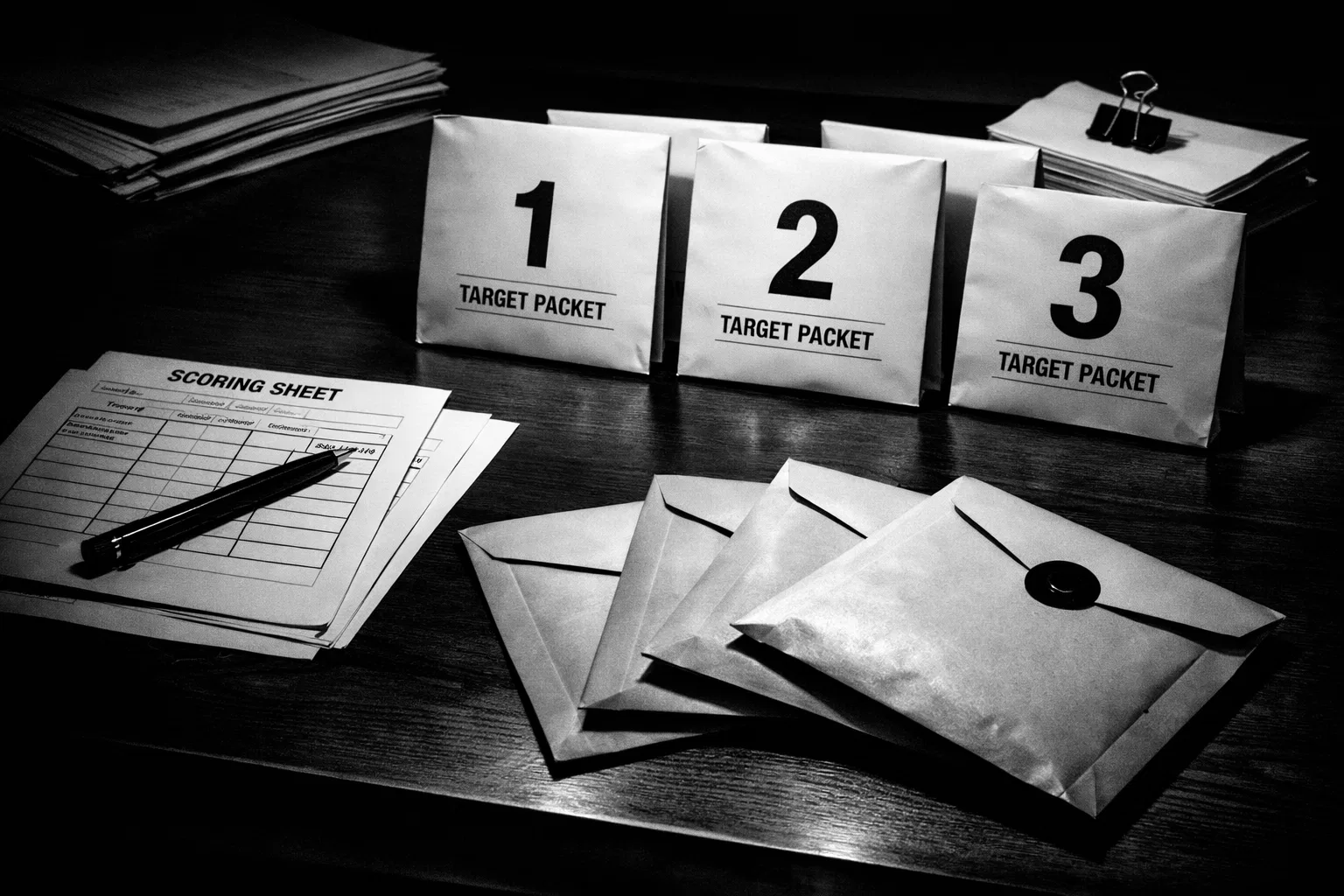
Most SAIC remote-viewing experiments were “free-response” studies. Instead of choosing from a small set of symbols, viewers described or sketched a hidden target: a photograph, location, object or short video segment. The value of this design was that it let viewers produce rich descriptions. The problem was that rich descriptions are hard to score objectively, because a response may contain many details, some wrong, some vague, and some strikingly close by chance.
SAIC and late SRI work commonly used rank-order judging to make this less subjective. After a session, a blind judge compared the viewer’s response with five possible targets: the actual target and four decoys. The judge ranked the five, with rank one as the best match. By chance, the correct target should average rank three. If the correct targets averaged significantly better than three across trials, researchers treated that as evidence for anomalous cognition.[UC Irvine Bren School]ics.uci.eduUC Irvine Bren Schoolics.uci.eduUC Irvine Bren Schoolics.uci.edu
This method had strengths. It made the chance expectation explicit, and it could remain statistically valid even when experienced viewers became familiar with the broad target pool, because the actual target was still randomly selected from possible alternatives.[UC Irvine Bren School]ics.uci.eduUC Irvine Bren Schoolics.uci.eduUC Irvine Bren Schoolics.uci.edu But it also concentrated enormous importance in the judging process. If one judge repeatedly knows the viewers’ styles, uses the same target pool, or applies the same scoring habits, then a later reviewer must ask whether the apparent effect belongs to the viewer, the target, the judge, the scoring procedure, or some interaction among them.
SAIC also explored design questions that mattered to parapsychologists. Some experiments compared static picture targets with dynamic video targets. Others tested whether a sender was needed, whether target characteristics such as visual complexity might affect success, and whether particular viewers were consistently better. In one account of Experiment One, five experienced viewers worked from home, faxed session material to principal investigator Nevin Lantz, and were randomly assigned conditions involving static or dynamic targets and the presence or absence of a sender.[UC Irvine Bren School]ics.uci.eduUC Irvine Bren Schoolics.uci.eduUC Irvine Bren Schoolics.uci.edu
The later work therefore shifted the debate away from simple “psychic spying” stories and towards laboratory design. The strongest SAIC claims depended on statistical patterns across controlled sessions, not on a single dramatic intelligence hit.
Laboratory Design Issues
The SAIC studies are often remembered as cleaner than the older SRI work, and that is fair in one limited sense. AIR noted that later research attempted to control many early flaws and that post-National Research Council procedures showed significant methodological improvements.[National Security Archive]nsarchive2.gwu.eduNational Security Archiveremote~1.PD FNational Security Archiveremote~1.PD F Yet the remaining problems were subtle rather than crude, which made them harder to resolve.
The most important issue was not simply whether someone peeked at a target. It was whether the whole experimental system was too narrow to support a general conclusion. The AIR discussion identified a central concern: most significant findings in the current programme used the same remote viewers, the same judge, the same target set and the same scoring procedures. This raised the possibility of “monomethod bias”, meaning that repeated use of one experimental arrangement might produce a statistical effect without proving a general paranormal ability.[National Security Archive]nsarchive2.gwu.eduNational Security Archiveremote~1.PD FNational Security Archiveremote~1.PD F
The role of the judge became especially contentious. In the SAIC remote-viewing work, the judge was often the principal investigator, someone familiar with the viewers and the research paradigm. AIR stated that cross-judge agreement needed to be demonstrated and that studies should be replicated using independent judges before strong claims could be made about remote viewing.[National Security Archive]nsarchive2.gwu.eduNational Security Archiveremote~1.PD FNational Security Archiveremote~1.PD F
A later critique by Richard Wiseman and Julie Milton focused on Experiment One, one of the key SAIC studies. Their research archive summary says the paper examined four possible methodological problems, found severe difficulty reconstructing important unrecorded procedural details, and argued that two flaws might be able to account for the study’s outcome.[uhra.herts.ac.uk]uhra.herts.ac.ukExperiment One of the SAIC Remote Viewing Program: A critical re-evaluationExperiment One of the SAIC Remote Viewing Program: A critical re-evaluation In the paper itself, they emphasised a standard concern in ESP research: people who know the target should not transcribe, edit or otherwise handle responses before judging, because ordinary information can leak through subtle channels.[Koestler Unit]koestlerunit.wordpress.comKoestler Unit Experiment One of the SAIC Remote Viewing ProgramKoestler UnitExperiment One of the SAIC Remote Viewing ProgramJuly 8, 2015 — by R Wiseman · Cited by 24 — This is to minimise the possibi…
Target type also complicated the case. Hyman pointed out an inconsistency between SAIC and ganzfeld research. Autoganzfeld studies had reported significant effects for dynamic targets but not static ones, whereas one SAIC experiment reportedly found significance for static targets while dynamic targets yielded no effect. A later SAIC experiment narrowed the dynamic-target “bandwidth” and found static and dynamic targets performing similarly, but Hyman argued that it was unclear whether this supported consistency or highlighted inconsistency.[National Security Archive]nsarchive2.gwu.eduNational Security Archiveremote~1.PD FNational Security Archiveremote~1.PD F
That detail matters because a robust phenomenon should become clearer as methods improve. In the SAIC debate, however, improvements often produced new interpretive puzzles. Was the effect linked to target vividness, viewer skill, judging familiarity, feedback, expectation, or something not yet specified? Without a stable pattern, the laboratory claim remained statistically interesting but scientifically fragile.
How Utts Read the SAIC Results
Utts gave the SAIC work its strongest official defence. Her position was not that every remote-viewing session was accurate or that the programme had proved a usable spy tool. Her claim was narrower and more statistical: using standards normally applied in science, the accumulated laboratory evidence showed effects far beyond what chance should produce.[ResearchGate]researchgate.netResearch Gate An Assessment of the Evidence for Psychic FunctioningResearch Gate An Assessment of the Evidence for Psychic Functioning
In her explanation of rank-order judging, Utts stressed that the random element lies in the target selection, not in the viewer’s response. Since the target is randomly chosen from a defined set, the judge’s rankings can be compared with what chance predicts. If correct targets repeatedly receive better ranks than expected, she argued, that provides evidence for anomalous cognition.[UC Irvine Bren School]ics.uci.eduUC Irvine Bren Schoolics.uci.eduUC Irvine Bren Schoolics.uci.edu
Utts also acknowledged methodological concerns, but she drew a different conclusion from Hyman. She argued that later SRI and SAIC work had reasonable methodological rigour, with some exceptions, and that the results were not easily dismissed as artefacts.[UC Irvine Bren School]ics.uci.eduUC Irvine Bren Schoolics.uci.eduUC Irvine Bren Schoolics.uci.edu In public reporting at the time, her conclusion was presented as a claim that remote viewing had produced credible statistical evidence, though not necessarily a reliable operational tool.[UC Davis]ucdavis.edupsychic spying research produces credible evidencepsychic spying research produces credible evidence
The key to understanding Utts is that she treated replication across related parapsychology findings as meaningful. If SAIC, SRI and other laboratories were producing effects of comparable magnitude under increasingly careful procedures, then she saw the burden shifting towards explaining how the effect worked rather than repeatedly asking whether it existed. AIR summarised her position as believing that the phenomenon had been adequately demonstrated and that future work should focus on causative mechanisms.[National Security Archive]nsarchive2.gwu.eduNational Security Archiveremote~1.PD FNational Security Archiveremote~1.PD F
How Hyman and AIR Read the Same Evidence
Hyman did not dismiss the SAIC statistics as mere random noise. That is one reason the 1995 debate remains more interesting than a simple believer-versus-sceptic story. AIR reported that both Utts and Hyman agreed that, considered broadly, the laboratory studies had produced statistically significant effects and that the newer procedures improved on earlier methods.[National Security Archive]nsarchive2.gwu.eduNational Security Archiveremote~1.PD FNational Security Archiveremote~1.PD F
The disagreement was over attribution. Hyman’s position was that a statistically significant effect does not by itself show that the cause is paranormal. Statistical significance can arise from overlooked artefacts, hidden dependencies, judging practices, selective design choices, or normal psychological processes. AIR summarised the central split clearly: Utts believed competing explanations had been adequately eliminated; Hyman believed they had not.[National Security Archive]nsarchive2.gwu.eduNational Security Archiveremote~1.PD FNational Security Archiveremote~1.PD F
AIR ultimately sided with caution. Its conclusion was that direct evidence had not shown that paranormal ability was the source of the effects. For the present laboratory set, the repeated use of the same viewers, judge, target set and scoring procedures made it difficult or impossible to localise the source of the phenomenon.[National Security Archive]nsarchive2.gwu.eduNational Security Archiveremote~1.PD FNational Security Archiveremote~1.PD F
This distinction is crucial. AIR did not say the SAIC experiments were worthless. It said they were not enough to establish the cause of the effect, and they did not demonstrate the strong, consistent performance needed for practical application. The same report noted that weak or inconsistent laboratory effects may be scientifically intriguing while still being too erratic to guide action.[National Security Archive]nsarchive2.gwu.eduNational Security Archiveremote~1.PD FNational Security Archiveremote~1.PD F
Operational value was an even higher bar. The evaluation was commissioned partly to decide whether the research had long-term practical value for intelligence, and AIR separately reviewed how remote-viewing reports had actually been used.[National Security Archive]nsarchive2.gwu.eduNational Security Archiveremote~1.PD FNational Security Archiveremote~1.PD F Later summaries of the 1995 review record the blunt operational conclusion: remote viewing, as practised in the current programme, had not been shown to have value in intelligence operations.[Center for Inquiry]cdn.centerforinquiry.orgOpen source on centerforinquiry.org.

The Legacy of the SAIC Claims
The SAIC experiments left remote viewing with a complicated legacy. Supporters could point to a late government-sponsored research programme where careful reviewers acknowledged statistically significant laboratory effects. Critics could point to the same evaluation and say the effects had not been causally pinned down, independently generalised, or converted into reliable intelligence.
That ambiguity is why SAIC still appears in later remote-viewing discussions. Modern pro-remote-viewing accounts often cite the Utts conclusion and the apparent methodological improvement over early SRI work. More sceptical accounts cite Hyman, AIR’s monomethod concerns, the single-judge problem, and later critiques of Experiment One. Both sides are responding to a real feature of the record: SAIC was strong enough to prevent an easy dismissal, but not strong enough to deliver scientific closure.
The most useful way to read the SAIC episode is as a case study in the difference between three claims:
- A statistical anomaly occurred: Utts, Hyman and AIR broadly agreed that the laboratory database contained statistically significant effects.
- The anomaly was paranormal remote viewing: Utts argued yes; Hyman and AIR said the evidence did not justify that causal conclusion.
- The method was useful for intelligence: the official evaluation found the evidence inadequate for practical operational value.
That separation is the enduring lesson. SAIC did not simply “prove remote viewing”, and it did not simply erase the laboratory results. It showed how a controversial effect can survive basic statistical scrutiny while still failing the harder tests of independent replication, causal explanation, cross-judge robustness and practical reliability.
Amazon book picks
Further Reading
Books and field guides related to The Later Tests Behind the 1995 Debate. Use these as the next step if you want deeper reading beyond the article.
Phenomena: The Secret History of the U.S. Government's Invest...
Explains the later experiments and 1995 review in historical context.
Phenomena
Covers the military and intelligence context behind remote viewing and the lab-to-operations gap.
The Demon-Haunted World: Science as a Candle in the Dark
Offers the broader scientific context for evaluating SAIC findings.
The Conscious Universe: The Scientific Truth of Psychic Pheno...
Discusses statistical evidence cited by supporters.
eBay marketplace picks
Marketplace Samples
Live-tested eBay searches with available results related to this page.

Endnotes
1.
Source: researchgate.net
Title: 267978941 Evaluation of Program on ‘Anomalous Mental Phenomena’
Link:https://www.researchgate.net/publication/267978941Evaluation_of_Program_on%27Anomalous_Mental_Phenomena%27
Source snippet
Evaluation of Program on 'Anomalous Mental Phenomena'January 1, 1995 — We focussed on the ten most recent experiments which w...
Published: January 1, 1995
2.
Source: uhra.herts.ac.uk
Title: Experiment One of the SAIC Remote Viewing Program: A critical re-evaluation
Link:https://uhra.herts.ac.uk/id/eprint/2331/
3.
Source: researchgate.net
Title: Research Gate An Assessment of the Evidence for Psychic Functioning
Link:https://www.researchgate.net/publication/333228024_An_Assessment_of_the_Evidence_for_Psychic_Functioning
4.
Source: cia.gov
Link:https://www.cia.gov/readingroom/docs/CIA-RDP96-00791R000200180005-5.pdf
5.
Source: cia.gov
Link:https://www.cia.gov/readingroom/document/cia-rdp96-00791r000200180005-5
6.
Source: cia.gov
Link:https://www.cia.gov/readingroom/docs/CIA-RDP96-00791R000200180006-4.pdf
7.
Source: cia.gov
Link:https://www.cia.gov/readingroom/docs/CIA-RDP96-00789R003200290001-5.pdf
8.
Source: cia.gov
Link:https://www.cia.gov/readingroom/docs/CIA-RDP96-00789R003200280001-6.pdf
9.
Source: researchgate.net
Link:https://www.researchgate.net/publication/402834861Unified_Classical_Resonance_Model_UCRM_Resonant_Plasmoids_Bio-ELFPsionics_Sixth_Oscillator_Remote_ViewingESP_Anomalous_Cognition_Gravity_Control_and_Zero-Point_Energy_Rectification-_The_MC-BE-CIRE_Hy
10.
Source: researchgate.net
Title: 387477192 New Graduate Level Education in Parapsychology on the Horizon
Link:https://www.researchgate.net/publication/387477192_New_Graduate-Level_Education_in_Parapsychology_on_the_Horizon
11.
Source: researchgate.net
Link:https://www.researchgate.net/figure/Experiments-Listed-by-Dr-Edwin-May_tbl1_250509613
12.
Source: researchgate.net
Link:https://www.researchgate.net/publication/253424455_The_Correlation_of_the_Gradient_of_Shannon_Entropy_and_Anomalous_Cognition_Toward_an_AC_Sensory_System
13.
Source: researchgate.net
Link:https://www.researchgate.net/scientific-contributions/Richard-Wiseman-2163512760/publications/5
14.
Source: researchgate.net
Link:https://www.researchgate.net/publication/344470071_THE_ASSOCIATIVE_REMOTE_DREAMING_EXPERIMENT_A_NOVEL_APPROACH_TO_PREDICTING_FUTURE_OUTCOMES_OF_SPORTING_EVENTS
15.
Source: nsarchive2.gwu.edu
Title: National Security Archiveremote~1.PD F
Link:https://nsarchive2.gwu.edu/NSAEBB/NSAEBB438/docs/doc_57.pdf
16.
Source: ics.uci.edu
Title: UC Irvine Bren Schoolics.uci.edu
Link:https://www.ics.uci.edu/~jutts/air
17.
Source: koestlerunit.wordpress.com
Title: Koestler Unit Experiment One of the SAIC Remote Viewing Program
Link:https://koestlerunit.wordpress.com/wp-content/uploads/2015/06/wiseman-milton-1998.pdf
Source snippet
Koestler UnitExperiment One of the SAIC Remote Viewing ProgramJuly 8, 2015 — by R Wiseman · Cited by 24 — This is to minimise the possibi...
Published: July 8, 2015
18.
Source: ucdavis.edu
Title: psychic spying research produces credible evidence
Link:https://www.ucdavis.edu/news/psychic-spying-research-produces-credible-evidence
19.
Source: cdn.centerforinquiry.org
Link:https://cdn.centerforinquiry.org/wp-content/uploads/sites/29/1996/03/22165045/p27.pdf
20.
Source: Wikipedia
Title: Remote viewing
Link:https://en.wikipedia.org/wiki/Remote_viewing
21.
Source: Wikipedia
Title: Jessica Utts
Link:https://en.wikipedia.org/wiki/Jessica_Utts
22.
Source: independent.academia.edu
Title: Edwin May
Link:https://independent.academia.edu/EdwinMay
23.
Source: richardwiseman.wordpress.com
Link:https://richardwiseman.wordpress.com/research/parapsychology/
24.
Source: ics.uci.edu
Link:https://www.ics.uci.edu/~jutts/hyman.html
25.
Source: ics.uci.edu
Link:https://www.ics.uci.edu/~jutts/may.pdf
Additional References
26.
Source: youtube.com
Title: Edwin May, Psychic Spying (Remote Viewing, [Star Gate]({{ ‘star-gate/’ | relative_url }}) Program)
Link:http://www.youtube.com/watch?v=xd6diALBBZw
Source snippet
Edwin May remote viewing SAIC CLASSIC REBOOT: Lessons Learned From the Stargate Program with Edwin C. May New Thinking Allowed with Jeffr...
27.
Source: youtube.com
Title: Dr. Edwin May, Psychic Theories (Precognition, Remote Viewing)
Link:http://www.youtube.com/watch?v=fk3f47jOAFs
Source snippet
Edwin May, Psychic Spying (Remote Viewing, Star Gate Program) - Jimmy Akin's Mysterious World...
28.
Source: youtube.com
Title: Classic Reboot: Training Anomalous Cognition with Edwin C. May
Link:http://www.youtube.com/watch?v=6vbb7E7UD30
Source snippet
Dr. Edwin May, Psychic Theories (Precognition, Remote Viewing) - Jimmy Akin's Mysterious World...
29.
Source: semanticscholar.org
Link:https://www.semanticscholar.org/paper/53bc4f446cc30b642ba7810b69b9c13b3fee61c8
30.
Source: slideshare.net
Link:https://www.slideshare.net/slideshow/an-evaluation-of-remote-viewing-research-and-applications-air1995pdf/257460594
31.
Source: mcfarlandbooks.com
Link:https://mcfarlandbooks.com/product/anomalous-cognition/?srsltid=AfmBOoqUkiokD9ihSF_cTtMlDWq2MDXtVPp6puveHUryaUp-Z_C7Mq7k
32.
Source: amazon.com
Link:https://www.amazon.com/Anomalous-Cognition-Remote-Viewing-Research/dp/0786494581?tag=searcht-20
33.
Source: reddit.com
Link:https://www.reddit.com/r/StrangerThings/comments/5pltwk/cia_documents_confirm_that_anomalous_cognition/
34.
Source: reddit.com
Link:https://www.reddit.com/r/Mars/comments/hpwnm9/cia_transcript/
35.
Source: facebook.com
Link:https://www.facebook.com/theurigeller/posts/central-intelligence-agency-as-a-result-of-gellers-success-in-this-experimental-/1290533545775148/
Topic Tree