Within Cold War
Why Fear Can Fund Unlikely Experiments
Remote viewing shows how Cold War agencies could fund unlikely tools when the cost of missing a surprise seemed higher than testing them.
On this page
- How surprise shaped Cold War decisions
- Why low cost tests seemed defensible
- Where risk logic stopped short of proof
Page outline Jump by section
Introduction
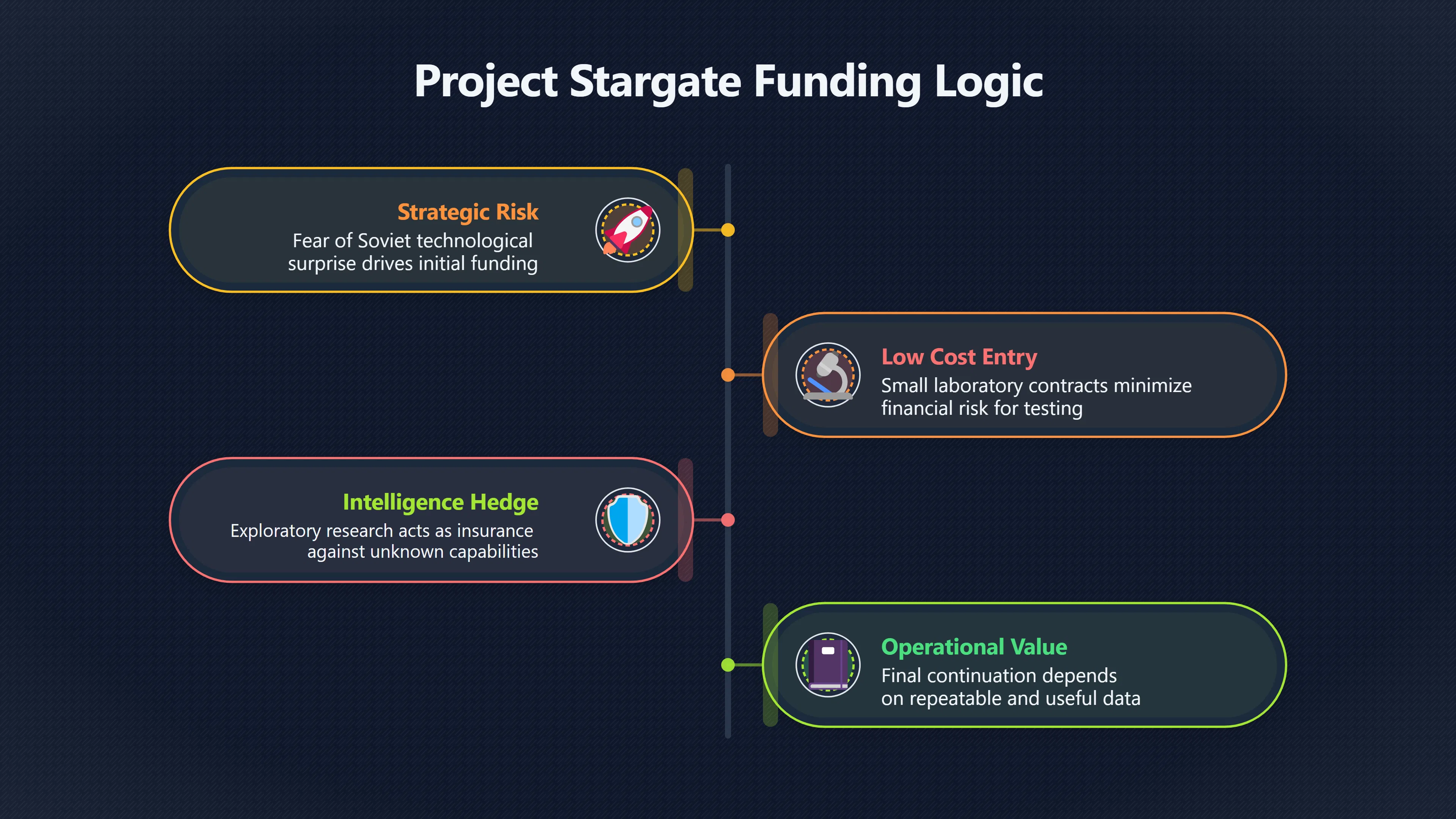
Remote viewing is often presented as an example of Cold War belief in psychic powers, but the more important lesson is about decision-making under uncertainty. U.S. intelligence agencies did not fund remote-viewing research because psychic perception had become scientifically accepted. Rather, they faced a strategic problem: if an adversary might discover an unconventional intelligence capability, the consequences of ignoring it could be greater than the relatively modest cost of investigating it. This “fear of surprise” shaped funding decisions throughout the Cold War, especially where Soviet research was difficult to interpret and the potential downside of being wrong appeared unusually high. The result was not an endorsement of paranormal claims, but a willingness to test unlikely possibilities before dismissing them.[CIA+2CIA]cia.govSTAR GATE PROJECT: AN OVERVIEWSTAR GATE effort is on anomalous phenomena, to include parapsychological and related biophysical interac…
How surprise shaped Cold War decisions
Cold War intelligence planning was heavily influenced by the risk of technological surprise. American officials had already experienced major strategic shocks, including the Soviet atomic bomb, rapid missile development and unexpected advances in space technology. Those experiences encouraged analysts to ask not only what the Soviet Union possessed, but what it might plausibly be trying to develop.
Claims about Soviet parapsychology therefore entered a security environment that rewarded caution. Declassified assessments examined Soviet and Eastern European work on telepathy, psychokinesis and what Soviet researchers often called “psychoenergetics”. These reports did not conclude that psychic intelligence gathering had been demonstrated. Instead, they attempted to determine whether Soviet investment signalled a capability that Western agencies could not afford to ignore.[CIA]cia.govTHE SOVIET PSYCHOENERGETICS RESEARCH PROGRAMTHE SOVIET PSYCHOENERGETICS RESEARCH PROGRAM - CIADEFENSE TECHNICAL INTELLIGENCE REPORT: THE SOVIET PSYCHOENERGETICS RESEARCH PROGRAM…
This distinction is important. Intelligence organisations routinely investigate uncertain foreign programmes without assuming those programmes will succeed. The question is whether uncertainty itself creates enough strategic risk to justify limited investigation. Remote viewing entered U.S. research through precisely that logic.
Why low-cost tests seemed defensible
Remote-viewing programmes remained relatively small compared with conventional military or intelligence spending. Because the financial commitment was limited, sponsors could argue that even a low probability of discovering a useful capability justified exploratory research.
Several practical considerations reinforced this reasoning:
- The cost of missing a genuine breakthrough appeared potentially enormous. If an adversary developed even a limited method of collecting intelligence beyond conventional means, the strategic consequences could outweigh years of modest research spending.
- Experimental funding was comparatively inexpensive. Laboratory contracts and small operational trials represented only a tiny fraction of defence research budgets.
- The research could also clarify foreign developments. Even if psychic functioning proved impossible, studying the subject could improve understanding of Soviet scientific priorities, propaganda or deception efforts.
- Programmes could remain compartmentalised. Classified administration allowed agencies to investigate controversial ideas without publicly committing institutional credibility.
This reasoning resembles what economists sometimes describe as an insurance calculation. The expected benefit need not be highly probable if the potential loss from overlooking a genuine capability is considered sufficiently severe. During the Cold War, that logic appeared in many speculative research areas, not only psychic phenomena.[CIA+2History]cia.govSTAR GATE PROJECT: AN OVERVIEWSTAR GATE effort is on anomalous phenomena, to include parapsychological and related biophysical interac…
Why uncertainty did not become proof
Fear of surprise explains why research began, but it does not explain why it continued. Intelligence organisations periodically reassessed whether experimental programmes produced operational value rather than merely intriguing laboratory results.
As remote-viewing projects evolved through programmes such as SCANATE, Grill Flame and eventually Star Gate, researchers reported individual sessions they regarded as impressive. However, intelligence customers required more than occasional successes. Operational collection had to produce information that was timely, specific, repeatable and useful for real-world decisions.
The programme therefore occupied an uneasy position. Advocates argued that some statistical findings and selected operational cases justified continued work. Critics responded that inconsistent performance, vague reporting and methodological weaknesses prevented reliable intelligence use. These competing interpretations persisted for years because neither side fully resolved the underlying scientific dispute.[CIA]cia.govAN EVALUATION OF THE REMOTE VIEWING PROGRAMIn 1995, the CIA declassified its past parapsychology program efforts in order to facilitat…
Where risk logic stopped short of proof
The most revealing aspect of the Star Gate story is not that agencies investigated remote viewing, but where they eventually drew the line.
In 1995, after the programme transferred to the CIA, the agency commissioned an independent review by the American Institutes for Research. The review distinguished between questions of scientific curiosity and intelligence usefulness. While reviewers disagreed over whether some laboratory results merited additional scientific investigation, they agreed that the programme had not produced intelligence sufficiently reliable for operational decision-making. Reports were often too vague, inconsistent or difficult to verify for routine use. The CIA subsequently terminated the programme.[CIA]cia.govAN EVALUATION OF THE REMOTE VIEWING PROGRAMIn 1995, the CIA declassified its past parapsychology program efforts in order to facilitat…
This outcome illustrates an important feature of Cold War risk management. Fear of surprise lowered the threshold for beginning exploratory research, but it did not permanently lower the threshold for evidence. Continued funding still depended on demonstrating practical value. Once independent evaluation concluded that remote viewing had failed to meet operational requirements, the original justification based on strategic uncertainty no longer outweighed the absence of dependable results.[CIA]cia.govAN EVALUATION OF THE REMOTE VIEWING PROGRAMIn 1995, the CIA declassified its past parapsychology program efforts in order to facilitat…
What the episode reveals about intelligence funding
Remote viewing is best understood as an example of how intelligence organisations manage uncertainty rather than as evidence that governments accepted paranormal claims. Decision-makers confronted an environment in which incomplete information about Soviet research made outright dismissal appear risky. Small exploratory programmes became acceptable because they were viewed as hedges against strategic surprise.
The episode also demonstrates the limits of that approach. Intelligence agencies may tolerate speculative hypotheses during early investigation, especially when costs are low and consequences of error seem potentially large. However, speculative funding does not eliminate the need for operational evidence. The Star Gate programme survived because uncertainty justified testing; it ended because decades of testing failed to establish the reliable intelligence capability that fear of surprise had originally been intended to discover.[CIA+2CIA]cia.govAN EVALUATION OF THE REMOTE VIEWING PROGRAMIn 1995, the CIA declassified its past parapsychology program efforts in order to facilitat…
Amazon book picks
Further Reading
Books and field guides related to Why Fear Can Fund Unlikely Experiments. Use these as the next step if you want deeper reading beyond the article.
The Men Who Stare At Goats
Rating: 3.5/5 from 11 Google Books ratings
Explores military willingness to test unusual ideas.

The imagineers of war
Shows how unconventional research can be funded under strategic uncertainty.
Phenomena
From the author of Nuclear War: A Scenario, this is the gripping story of how a select group of scientists, under the watchful eye of the...
eBay marketplace picks
Marketplace Samples
Live-tested eBay searches with available results related to this page.


Endnotes
1.
Source: cia.gov
Link:https://www.cia.gov/readingroom/docs/CIA-RDP96-00789R002800180001-2.pdf
Source snippet
STAR GATE PROJECT: AN OVERVIEWSTAR GATE effort is on anomalous phenomena, to include parapsychological and related biophysical interac...
2.
Source: cia.gov
Title: THE SOVIET PSYCHOENERGETICS RESEARCH PROGRAM
Link:https://www.cia.gov/readingroom/document/nsa-rdp96x00790r000100020003-3
Source snippet
THE SOVIET PSYCHOENERGETICS RESEARCH PROGRAM - CIADEFENSE TECHNICAL INTELLIGENCE REPORT: THE SOVIET PSYCHOENERGETICS RESEARCH PROGRAM...
3.
Source: history.com
Title: cia esp espionage soviet union cold war
Link:https://www.history.com/articles/cia-esp-espionage-soviet-union-cold-war
Source snippet
The CIA Recruited 'Mind Readers' to Spy on the Soviets in the 1970sOctober 17, 2018 — The CIA, Army and Defense Intelligence Agency recru...
Published: October 17, 2018
4.
Source: cia.gov
Link:https://www.cia.gov/readingroom/docs/NSA-RDP96X00790R000100010041-2.pdf
Source snippet
ficance of Soviet parapsychological research. SUMMARY AND CONCLUSIONS...
5.
Source: cia.gov
Link:https://www.cia.gov/readingroom/docs/CIA-RDP96-00791R000200180005-5.pdf
Source snippet
AN EVALUATION OF THE REMOTE VIEWING PROGRAMIn 1995, the CIA declassified its past parapsychology program efforts in order to facilitat...
6.
Source: Wikipedia
Title: Remote viewing
Link:https://en.wikipedia.org/wiki/Remote_viewing
Source snippet
Remote viewingA remote viewer is expected to give information about an object, event, person, or location hidden from physical view an...
Additional References
7.
Source: reddit.com
Link:https://www.reddit.com/r/todayilearned/comments/1c08wm5/til_that_project_[stargate
Source snippet
TIL that Project Stargate was a CIA plan to use psychic...The project primarily focused on Remote Viewing and supposed ability to psychi...
8.
Source: medium.com
Link:https://medium.com/the-peculiar-truth/the-peculiar-truth-about-the-cias-project-stargate-61ac0534d2f4
Source snippet
The Peculiar Truth about the CIA's Project StargateBoth claimed to have been engaged in remote viewing operations. Price, Puthoff, and In...
9.
Source: esd.whs.mil
Link:https://www.esd.whs.mil/Portals/54/Documents/FOID/Reading%20Room/International_Security_Affairs/paranormal_briefing.pdf
Source snippet
Soviet term for "parapsychology"; 11 study of energetic processes11 probably refers to psychokinesis~ and 11 biologicol...
10.
Source: academia.edu
Link:https://www.academia.edu/95285973/The_Star_Gate_Operational_Remote_Viewing_Program_A_Human_Intelligence_HUMINT_Collection_Platform
Source snippet
The AIR Report)... Operational Remote Viewing: A HUMINT Platform The primary reason for...Read more...
11.
Source: greydynamics.com
Link:https://greydynamics.com/intelligence-past-the-tangible-world-cias-stargate-project/
Source snippet
Intelligence Past the Tangible World: CIA's Stargate ProjectRemote Viewing (RV) as a tool for intelligence gathering gained footing...
12.
Source: facebook.com
Title: attempting to spy on enemies using psychic powers
Link:https://www.facebook.com/historyoasis/posts/from-1972-to-1995-the-united-states-military-invested-over-20-million-in-one-of-/790173214116954/
Source snippet
The Stargate...February 4, 2026 — The project emerged from Cold War paranoia. In 1970, U.S. intelligence believed the Soviet Union was s...
Published: February 4, 2026
13.
Source: scribd.com
Link:https://www.scribd.com/doc/92017954/Air-Report
Source snippet
ze a place, location, or object being viewed by a "beacon" or...Read more...
14.
Source: Wikipedia
Title: Stargate Project (U.S. Army unit)
Link:https://en.wikipedia.org/wiki/Stargate_Project_%28U.S._Army_unit%29
Source snippet
Stargate Project (U.S. Army unit)The Stargate Project's work primarily involved remote viewing, the purported ability to psychically "...
15.
Source: researchgate.net
Title: (PDF) Follow‐up on the U.S
Link:https://www.researchgate.net/publication/370491006_Follow-up_on_the_US_Central_Intelligence_Agency%27s_CIA_remote_viewing_experiments
Source snippet
Central Intelligence Agency's...Objectives Since 1972, the U.S. Central Intelligence Agency (CIA) commissioned several research programs...
16.
Source: hypothes.is
Title: FWCtxpr QEe Mu7e1Agc85g
Link:https://hypothes.is/a/FWCtxprQEe-Mu7e1Agc85g
Source snippet
is4 Nov 2024 — According to AIR, which performed a review of the project, no remote viewing report ever provided actionable infor...
Topic Tree