Within Sketches
Why One Circle Can Match Too Much
A circle, tower, or cluster of lines can look persuasive only after the target is known, making judging controls essential.
On this page
- Reusable marks and flexible meanings
- How target knowledge reshapes interpretation
- Ways blind judging reduces retrofit matches
Page outline Jump by section
Introduction
Simple sketches occupy an awkward place in remote-viewing research. They can preserve an immediate visual impression before a viewer begins attaching names or stories to it, but they are also unusually easy to reinterpret after the correct target has been revealed. A single circle may be described as a dome, a pond, a wheel, a stadium, a radar dish or the top of a tower depending on what the judge already knows. This flexibility creates a major evidential risk: a drawing that looked vague before feedback can appear strikingly accurate afterwards.
For that reason, debates about remote-viewing sketches have focused less on artistic quality than on judging procedures. Critics argue that loose, abstract marks invite hindsight interpretation, while both sceptical researchers and many remote-viewing practitioners agree that blind judging and pre-specified scoring are essential if sketches are to carry meaningful evidential weight.[Wikipedia]WikipediaRemote viewingRemote viewing
Why One Circle Can Match Too Much
The problem is not that viewers draw simple shapes. It is that many real-world scenes share simple geometric features.
A rough circle may correspond to:
- a water tank
- a fountain
- a crater
- a storage silo
- a sports arena
- a roundabout
- a radar installation
- the top view of a tower
Likewise, several vertical strokes may resemble trees, antennae, columns, chimneys, cranes or skyscrapers. Once the actual target is known, it becomes easy to emphasise whichever interpretation appears closest while ignoring equally plausible alternatives.
This is a classic example of retrospective matching. Instead of asking, “What would this sketch have predicted before anyone knew the answer?”, the interpretation becomes, “How can this sketch be made to resemble the known target?” That distinction is central to evaluating free-response methods such as remote viewing.[Wikipedia]WikipediaRemote viewingRemote viewing
Reusable Marks and Flexible Meanings
Many remote-viewing sketches rely on broad spatial impressions rather than precise representation. Curves, enclosed areas, intersecting lines and clusters are intentionally quick because they attempt to capture an immediate impression before conscious analysis develops.
That speed, however, produces symbols that are highly reusable. The same mark can reasonably fit numerous unrelated targets.
For example:
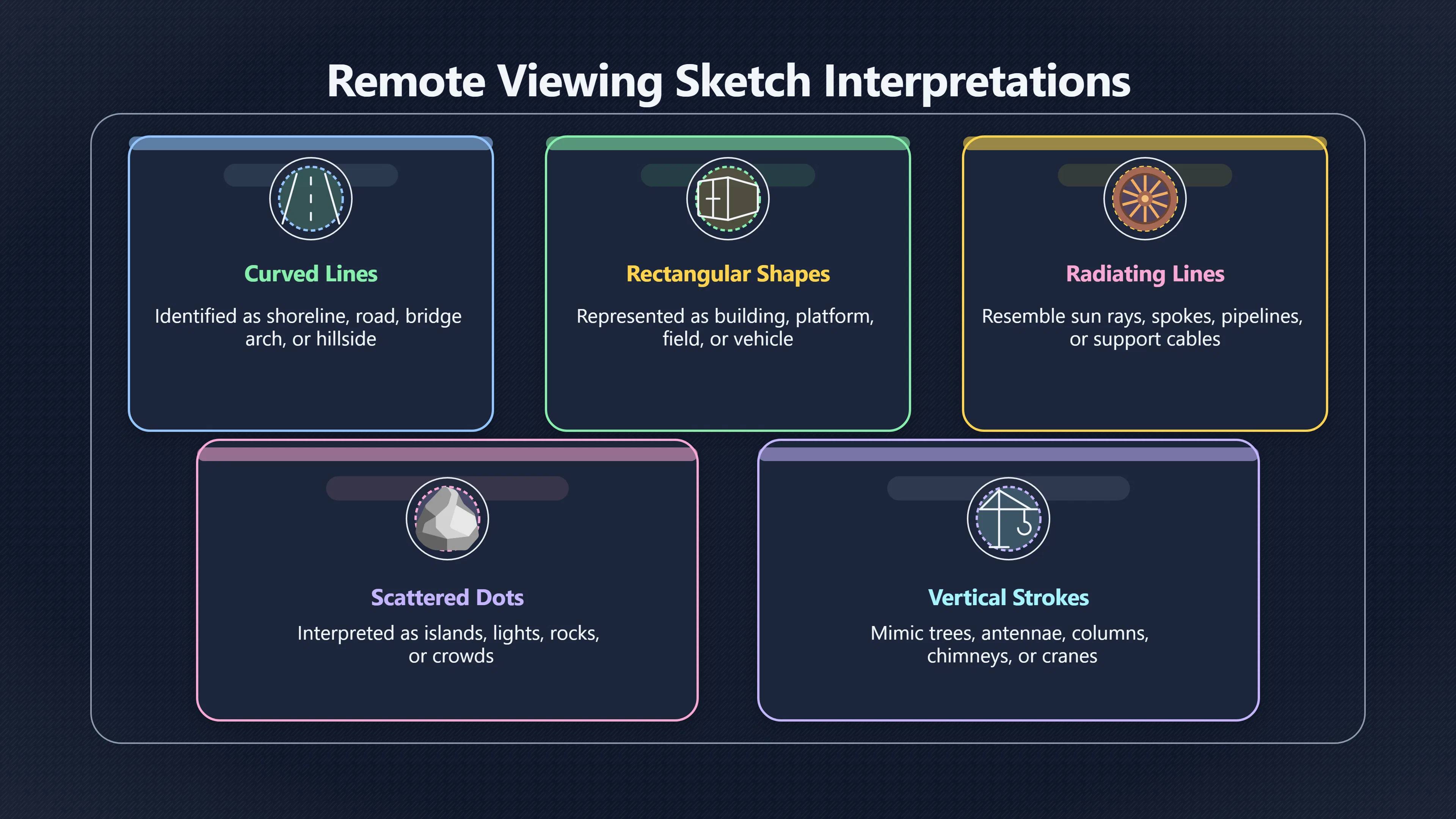
- A curved line may later be identified as a shoreline, road, bridge arch or hillside.
- A rectangle may become a building, platform, field or vehicle.
- Radiating lines may resemble sun rays, spokes, pipelines, branches or support cables.
- Scattered dots may be interpreted as islands, lights, rocks, trees or crowds.
Because each individual feature is common, almost any complex photograph contains at least some elements that appear compatible with the drawing. The more abstract the sketch, the larger the pool of possible matches.
This is one reason that experienced evaluators generally consider isolated similarities much weaker than distinctive combinations of independent features.
How Target Knowledge Reshapes Interpretation
Knowing the target changes how people perceive ambiguous images. Cognitive psychology has long shown that expectations influence perception and memory, making ambiguous stimuli appear more meaningful once context is supplied.
Applied to remote viewing, this means a judge who already knows the correct photograph cannot easily return to the perspective they had before seeing it. Details that previously seemed insignificant may suddenly become important, while inconsistent features receive less attention.
For example, imagine a sketch consisting of one large circle with two vertical lines beside it.
Before feedback, dozens of interpretations are possible.
After learning that the target is a lighthouse, the circle may become the lantern room and the lines nearby buildings. If the target instead proves to be an oil storage facility, the circle becomes a storage tank. If the target is a Ferris wheel, the same circle appears remarkably appropriate again.
None of these reinterpretations necessarily involves deliberate bias. They arise because human pattern recognition naturally seeks coherent matches once the solution is available. This hindsight effect makes post hoc evaluation especially vulnerable unless safeguards are built into the judging process.[Wikipedia]WikipediaRemote viewingRemote viewing
Why Distinctive Sketches Carry More Weight
Not every drawing has the same retrofit risk.
Sketches become more informative when they contain multiple unusual relationships rather than isolated geometric elements. A drawing showing a circular structure connected to a long narrow causeway beside a sharply angled shoreline is harder to reinterpret than a single circle or a few vertical strokes.
The evidential value therefore depends less on whether one feature resembles the target than on whether numerous independent features align simultaneously in a way that would have been unlikely across many alternative targets.
Researchers evaluating free-response protocols have consequently emphasised complete pattern correspondence rather than selective feature matching.
Ways Blind Judging Reduces Retrofit Matches
Because retrofit interpretation cannot easily be eliminated through subjective judgement alone, remote-viewing experiments have developed procedural controls intended to reduce it.
The strongest protections include:
- Blind judging, where judges do not know which target is correct while evaluating transcripts and sketches.
- Multiple decoy targets, requiring the sketch to be ranked against several plausible alternatives rather than compared with only the true target.
- Predefined scoring rules, established before judging begins to reduce ad hoc interpretation.
- Independent judges, allowing agreement to be measured instead of relying on a single evaluator.
These procedures force sketches to compete against other images that may also contain circles, towers, rivers or clusters of lines. If a drawing consistently ranks the correct target above realistic alternatives, it provides stronger evidence than a retrospective comparison with only one known image.
Both supporters seeking rigorous protocols and critics evaluating experimental quality have highlighted blind judging as one of the most important safeguards against flexible interpretation. Conversely, studies criticised for allowing sensory cues, target knowledge or subjective matching have been cited as examples of how apparently impressive sketches can lose their evidential force when stricter controls are applied.[Wikipedia]WikipediaRemote viewingRemote viewing
The Main Critique
The retrofit problem does not prove that every successful remote-viewing sketch is meaningless. Rather, it identifies a mechanism by which ordinary pattern recognition can create an exaggerated impression of accuracy.
A rough circle is persuasive only if it distinguishes one target from competing alternatives before the answer is known. Once the target has been revealed, the same mark can often be fitted to many different scenes. That is why the credibility of sketch-based remote-viewing claims depends less on the drawing itself than on the quality of the judging process used to interpret it.[Wikipedia]WikipediaRemote viewingRemote viewing
Amazon book picks
Further Reading
Books and field guides related to Why One Circle Can Match Too Much. Use these as the next step if you want deeper reading beyond the article.
The Signal and the Noise
Helps readers distinguish meaningful patterns from coincidence.
The Full Facts book of Cold Reading
Directly addresses retrospective interpretation and flexible matching.
Parapsychology: A Handbook for the 21st Century
Provides balanced discussion of psi research methods.
eBay marketplace picks
Marketplace Samples
Live-tested eBay searches with available results related to this page.
Endnotes
1.
Source: Wikipedia
Title: Remote viewing
Link:https://en.wikipedia.org/wiki/Remote_viewing
2.
Source: Wikipedia
Title: [Sensory leakage]({{ ‘leakage/’ | relative_url }})
Link:https://en.wikipedia.org/wiki/Sensory_leakage
Additional References
3.
Source: pure.au.dk
Link:https://pure.au.dk/ws/files/271351886/Exploring_blind_spots_in_collaborative_value_creation_in_building_design_a_creativity_perspective_Accepted_manuscript.pdf
Source snippet
sheetby MM Biskjaer · 2021 · Cited by 19 — Using the seminal four p model from creativity research (person, process, product, and press)...
4.
Source: aj.arch.chula.ac.th
Link:https://www.aj.arch.chula.ac.th/nakhara/files/article/51-131-1-PB.pdf
Source snippet
the Origin of Drawing to Cinemetricsby CL Hsueh · Cited by 5 — Carefully investigating the architectural blind spots, disappearances and...
5.
Source: journals.open.tudelft.nl
Link:https://journals.open.tudelft.nl/footprint/issue/archive
Source snippet
FOOTPRINTThe articles and reviews included in the issue examine the potential purpose such appraisal might have, who should do it, and...
6.
Source: pure.uva.nl
Link:https://pure.uva.nl/ws/files/44663647/Chapter_2.pdf
Source snippet
uva.nl2: Site-specific installation art from an historical perspectiveThe chapter elucidates several art historical perspectives on both...
7.
Source: youtube.com
Title: Russell Targ teaches Remote Viewing in one simple lesson
Link:https://www.youtube.com/watch?v=FI_01m-6L30
Source snippet
Remote Viewing Ideograms and Sketches CRV Stage 1 2 3 Learn How To Remote View In Less Than 20 Minutes...
8.
Source: assets.moma.org
Title: moma catalogue 178 300296452
Link:https://assets.moma.org/documents/moma_catalogue_178_300296452.pdf
Source snippet
art despite modernismThroughout the twentieth century, the evolution of mainstream modernism in the arts has been shadowed and complicate...
9.
Source: kalden.home.xs4all.nl
Title: h a steadman ENG
Link:https://kalden.home.xs4all.nl/vermeer-info/house/h-a-steadman-ENG.htm
Source snippet
xs4all.nlSteadman's first response to the Digital Vermeer House1 Mar 2017 — A discussion between Philip Steadman and Kees Kaldenbach on t...
10.
Source: youtube.com
Title: Learn How To Remote View In Less Than 20 Minutes!
Link:https://www.youtube.com/watch?v=Thq8sVv0lps
Source snippet
Russell Targ teaches Remote Viewing in one simple lesson - New Course 2025...
11.
Source: architecturenow.co.nz
Title: idea building
Link:https://architecturenow.co.nz/articles/idea-building/
Source snippet
Idea-building14 Feb 2022 — Daniel K Brown reflects on the ways in which abstract, speculative architectural drawings can play an importan...
12.
Source: journals.ap2.pt
Link:https://journals.ap2.pt/index.php/BBDS/article/download/1001/773
Source snippet
ap2.ptVor-textu(r)al Translations from Building to Drawingby R Charron · 2025 — Abstract. This essay looks at a tentative drawing procedu...
Topic Tree