Within CIA Myths
What a Declassified CIA File Really Proves
A released CIA file proves the record exists, not that the agency verified the claim inside it.
On this page
- What CREST release status does and does not mean
- Why raw session notes are not agency findings
- How to read letterhead, dates, and project labels
Page outline Jump by section
Introduction
A declassified CIA file proves that a document existed within the government’s records and that it was later released to the public. It does not prove that the CIA verified, endorsed or accepted every claim contained in that document. This distinction lies at the heart of many misunderstandings about remote-viewing records.
Remote-viewing files often appear persuasive because they carry official markings, project names and classification stamps. When viewed in isolation, they can resemble formal intelligence conclusions. In reality, many are raw session transcripts, research notes, contractor reports or administrative records preserved because they formed part of an intelligence programme’s history. Understanding what these documents are—and what they are not—is essential for reading the CIA archive accurately.
What CREST release status does and does not mean
The CIA’s CREST (CIA Records Search Tool) archive is a repository of declassified historical records. When the agency placed more than 12 million pages online, it described the collection as a broad historical archive covering many subjects, including the STAR GATE programme and related remote-viewing material. The release reflected a declassification decision, not a judgement that every document represented validated intelligence or accurate information.[Federation of American Scientists]fas.orgcrest cavityFederation of American ScientistsCIA's CREST Leaves Cavity in Public Domain4 Jun 2009 — “CREST” database of declassified documents instan…
That distinction is fundamental because intelligence archives preserve many different kinds of material, including:
- Draft memoranda.
- Incoming reports from other organisations.
- Contractor research.
- Experimental records.
- Operational paperwork.
- Internal correspondence.
- Final analytical assessments.
These categories do not carry the same evidential weight. A filed document demonstrates that officials considered, received or generated information. It does not automatically show that they believed it.
This is standard archival practice rather than something unique to remote viewing. Government archives routinely preserve unsuccessful experiments, disputed analyses and abandoned programmes alongside more authoritative assessments.
Why raw session notes are not agency findings
Many of the most widely shared remote-viewing documents are not intelligence conclusions at all. They are records of individual viewing sessions.
A typical session record may include:
- a target number;
- the viewer’s impressions;
- sketches or diagrams;
- descriptive phrases;
- comments from monitors;
- notes recorded before target feedback.
These documents were intended to capture what a participant reported during an experiment or operational task. They were not written as declarations that the reported perceptions were accurate.
Some CIA records explicitly describe their contents as raw remote-viewing input produced during training exercises or operational assignments. That wording is important because “raw” indicates information before evaluation, corroboration or analytical review.[CIA]cia.govAN EVALUATION OF THE REMOTE VIEWING PROGRAMIn 1995, the CIA declassified its past parapsychology program efforts in order to facilitat…
An analogy helps illustrate the point. A witness statement filed by police records what someone claimed to have seen. The existence of the statement proves the interview occurred; it does not prove every detail of the testimony is true. Remote-viewing session transcripts serve a similar documentary function.
How to read letterhead, dates and project labels
Official formatting can make speculative material appear more authoritative than it really is.
Readers frequently interpret the following features as proof of verification:
- CIA letterhead.
- Security classification markings.
- Declassification stamps.
- Project names such as STAR GATE.
- Viewer identification numbers.
- Distribution lists.
- Official file numbers.
In reality, these elements mainly establish provenance. They show where a document came from, when it was produced and how it moved through government systems.
They do not, by themselves, indicate:
- successful validation;
- agreement among analysts;
- operational use;
- scientific confirmation;
- institutional endorsement.
A remote-viewing worksheet on CIA stationery remains a worksheet unless another document demonstrates that its contents were independently verified and accepted.
Why later programme evaluations matter more than isolated documents
The strongest evidence for the CIA’s institutional position comes not from individual session records but from later programme evaluations.
When responsibility for the programme transferred to the CIA in the mid-1990s, the agency commissioned the American Institutes for Research (AIR) to conduct an independent review of the accumulated evidence. Rather than asking whether unusual documents existed, the reviewers examined whether the programme had demonstrated intelligence value.
The review concluded that the available evidence did not establish remote viewing as a useful operational intelligence tool. Although one reviewer, statistician Jessica Utts, argued that some experimental results merited further scientific investigation, psychologist Ray Hyman concluded that methodological weaknesses and lack of independent replication prevented the findings from supporting claims of paranormal functioning. The overall AIR assessment found no persuasive evidence that the programme had produced actionable intelligence for intelligence operations, and the programme was subsequently terminated.[CIA]cia.govAN EVALUATION OF THE REMOTE VIEWING PROGRAMIn 1995, the CIA declassified its past parapsychology program efforts in order to facilitat…
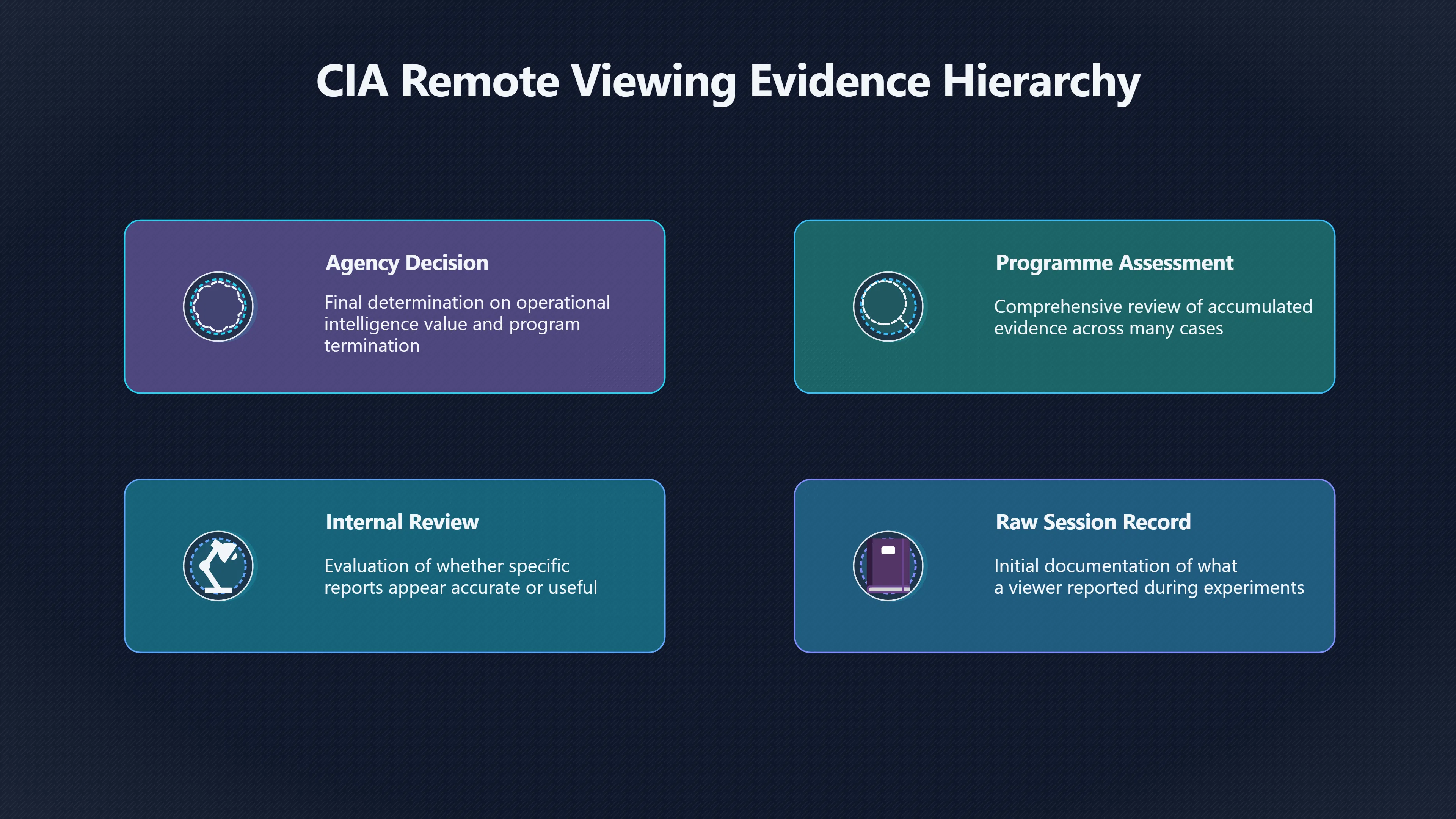
This illustrates an important hierarchy of evidence:
- Raw session record – documents what a viewer reported.
- Internal review – evaluates whether the report appears accurate.
- Programme assessment – considers the accumulated evidence across many cases.
- Agency decision – determines whether the programme should continue.
Confusing the first level with the last is one of the most common public misunderstandings.
Why individual “hits” do not settle the question
Supporters of remote viewing often highlight individual sessions that appear strikingly accurate. Critics point to sessions that were vague, incorrect or impossible to evaluate.
Both observations can be true simultaneously.
A research programme may contain individual cases that seem impressive while still failing to demonstrate reliable operational performance across hundreds of attempts. Intelligence agencies are interested in dependable methods rather than memorable anecdotes. The AIR review therefore examined the programme as a whole instead of relying on isolated successes.
This explains why dramatic excerpts frequently circulate online while the broader evaluation receives less attention. Individual transcripts are visually compelling and easy to share, whereas programme reviews require readers to compare many cases and consider statistical reliability.
A practical checklist for reading CIA remote-viewing files
When encountering a declassified remote-viewing document, ask several questions before treating it as evidence of an official conclusion:
- What type of document is it? Is it a session transcript, memorandum, evaluation or final report?
- Who wrote it? A viewer, monitor, contractor, analyst or senior official?
- Was the information independently verified? Look for follow-up analysis rather than assuming verification.
- Does another document assess the results? Session records are only one stage in the process.
- Does it reflect the agency’s final position? Later programme evaluations generally carry greater evidential weight than individual operational records.
Applying these questions helps distinguish historical documentation from institutional judgement.
The key distinction
The CIA archive confirms beyond doubt that the United States government funded, documented and preserved remote-viewing research over many years. It also confirms that those records have been declassified and made publicly available.
What it does not establish is that every statement contained within those records was accepted as true. Official letterhead authenticates a document’s origin, not its claims. Declassification authenticates release, not accuracy. The agency’s later evaluations—not isolated session notes—provide the clearest evidence of its institutional conclusions regarding the intelligence value of remote viewing.[CIA]cia.govAN EVALUATION OF THE REMOTE VIEWING PROGRAMIn 1995, the CIA declassified its past parapsychology program efforts in order to facilitat…
Amazon book picks
Further Reading
Books and field guides related to What a Declassified CIA File Really Proves. Use these as the next step if you want deeper reading beyond the article.
Phenomena: The Secret History of the U.S. Government's Invest...
Explains government psychic research and separates archival history from proof claims.
The Men Who Stare At Goats
Rating: 3.5/5 from 11 Google Books ratings
Provides accessible context for military psychic research myths.
The Demon-Haunted World
Helps readers evaluate extraordinary claims and documentary evidence critically.

Paranormality: Why We See What Isn't There
Explains why official-looking material is often overinterpreted.
eBay marketplace picks
Marketplace Samples
Live-tested eBay searches with available results related to this page.

Endnotes
1.
Source: cia.gov
Link:https://www.cia.gov/readingroom/docs/CIA-RDP96-00791R000200180005-5.pdf
Source snippet
AN EVALUATION OF THE REMOTE VIEWING PROGRAMIn 1995, the CIA declassified its past parapsychology program efforts in order to facilitat...
2.
Source: cia.gov
Link:https://www.cia.gov/readingroom/docs/cia-rdp96-00788r001700210016-5.pdf
Source snippet
ANALYSIS AND ASSESSMENT OF GATEWAY PROCESSendeavors to provide the subject with the tools by which he may alter his consciousness based o...
3.
Source: cia.gov
Link:https://www.cia.gov/readingroom/document/cia-rdp96-00788r001700210016-5
Source snippet
ANALYSIS AND ASSESSMENT OF GATEWAY PROCESSThe Gateway Experience is a training system designed to bring enhanced strength, focus, and coh...
4.
Source: archive.org
Title: cia readingroom document cia rdp96 00788r001700210016 5
Link:https://archive.org/details/cia-readingroom-document-cia-rdp96-00788r001700210016-5
Source snippet
CIA Reading Room cia-rdp96-00788r001700210016-5:...29 Jan 2024 — CIA Reading Room cia-rdp96-00788r001700210016-5: ANALYSIS AND ASSESSMEN...
5.
Source: archives.gov
Link:https://www.archives.gov/research/topics/uaps
Source snippet
to unidentified flying objects (UFO) and unidentified anomalous phenomena (UAP)...
6.
Source: fas.org
Title: crest cavity
Link:https://fas.org/publication/crest_cavity/
Source snippet
Federation of American ScientistsCIA's CREST Leaves Cavity in Public Domain4 Jun 2009 — “CREST” database of declassified documents instan...
Additional References
7.
Source: youtube.com
Link:https://www.youtube.com/watch?v=vpmKb1-T0FY
Source snippet
CIA Analysis And Assessment Of Gateway ProcessCIA Analysis And Assessment Of Gateway Process - Declassified Part One #shifting.Read more...
8.
Source: facebook.com
Title: Known as The Gateway Process, the report suggested
Link:https://www.facebook.com/QuantumCookie/posts/in-1983-a-declassified-cia-document-quietly-made-a-shocking-claim-about-the-powe/774838005638558/
Source snippet
In 1983, a declassified CIA document quietly made a...In 1983, a declassified CIA document quietly made a shocking claim about the power...
9.
Source: amazon.co.uk
Link:https://www.amazon.co.uk/CIA-Analysis-Assessment-Gateway-Process/dp/1963956036?tag=searcht-20
Source snippet
CIA Analysis and Assessment of Gateway ProcessThe CIA investigated this technique in 1983, focusing on psychic research and remote viewing...
10.
Source: youtube.com
Title: Bill Ray, Psychic Spy (Extended Remote Viewing, Star Gate, [Stargate]({{ ‘stargate/’ | relative_url }}))
Link:https://www.youtube.com/watch?v=l5XcosdhnNM
Source snippet
How the CIA worked with psychics on 'Project Stargate' | Reality Check with Ross Coulthart...
11.
Source: commons.wikimedia.org
Title: File:Analysis and Assessment of Gateway Process
Link:https://commons.wikimedia.org/wiki/File%3AAnalysis_and_Assessment_of_Gateway_Process.pdf
Source snippet
McDonnell. Retrieved from the CIA FOIA Reading Room. Page 25 from [https://archive.org/details/1983...Read](https://archive.org/details/1983...Read) more...
12.
Source: reddit.com
Link:https://www.reddit.com/r/Meditation/comments/1504nd6/analysis_and_assessment_of_gateway_process_cia/
Source snippet
ANALYSIS AND ASSESSMENT OF gateway process - CIAThe document is about Gateway, which is an at home or in person course at The Monroe Inst...
13.
Source: youtube.com
Title: Joe Mc Moneagle
Link:https://www.youtube.com/watch?v=XRTon6qgVws
Source snippet
Bill Ray, Psychic Spy (Extended Remote Viewing, Star Gate, Stargate) - Jimmy Akin's Mysterious World...
14.
Source: pmc.ncbi.nlm.nih.gov
Link:https://pmc.ncbi.nlm.nih.gov/articles/PMC10275521/
Source snippet
Central Intelligence Agency's (CIA...by Á Escolà‐Gascón · 2023 · Cited by 10 — Since 1972, the U.S. Central Intelligence Agency (CIA) co...
15.
Source: muckrock.com
Title: crest search guide
Link:https://www.muckrock.com/news/archives/2017/sep/22/crest-search-guide/
Source snippet
The ultimate guide to searching CIA's declassified archives22 Sept 2017 — This guide will tell you everything you need to know to dive in...
16.
Source: youtube.com
Title: Inside Operation Stargate: The CIA’s Psychic Spy Experiment
Link:https://www.youtube.com/watch?v=oasTnsLw_n8
Source snippet
Joe McMoneagle - CIA's Project Stargate | SRS #95...
Topic Tree