Within Intel Value
How Bad Clues Could Waste Real Resources
A report mixing possible clues with errors could waste resources by sending analysts toward misleading leads.
On this page
- Why mixed signal and noise is dangerous
- How analysts might misread stray impressions
- The operational cost of chasing weak leads
Page outline Jump by section
Introduction
One of the most important operational criticisms of remote viewing was not simply that reports could be wrong, but that they could be partly right. In intelligence work, a report containing a mixture of plausible observations, irrelevant impressions and outright errors can be more problematic than one that is obviously false. A completely incorrect lead is often discarded quickly. A report containing enough apparently accurate detail to seem credible may instead encourage analysts to devote time, surveillance assets and investigative effort to directions that ultimately prove unproductive. The central concern raised by official evaluations of the U.S. Star Gate programme was therefore not merely accuracy in isolation, but whether remote-viewing reports could reliably help decision-makers avoid costly investigative blind alleys. The 1995 American Institutes for Research (AIR) review concluded that they could not, finding that reports were frequently vague, inconsistent and mixed with erroneous information, and had never been used to guide intelligence operations.[CIA]cia.govAN EVALUATION OF THE REMOTE VIEWING PROGRAMIn no case had the information provided ever been used to guide intelligence operations. Th…

Why Mixed Signal and Noise Is Dangerous
Intelligence analysis rarely evaluates a single isolated fact. Instead, analysts assemble many fragments into a coherent assessment. This means that information containing both genuine-looking observations and misleading details presents a particular challenge.
A remote-viewing report might include broad descriptions that appear to match known circumstances—references to water, industrial structures or military activity, for example—while simultaneously introducing inaccurate locations, incorrect timing or irrelevant features. Once investigators begin treating some parts of the report as potentially meaningful, distinguishing useful information from imaginative embellishment becomes increasingly difficult.
The AIR operational review recognised precisely this problem. Although reviewers accepted that some reports appeared to contain material that users judged “possibly” accurate, they found that the reports lacked the specificity, consistency and reliability required for operational intelligence. Broad impressions could appear convincing after events became known, yet they seldom identified concrete actions that intelligence officers could confidently take beforehand.[CIA]cia.govAN EVALUATION OF THE REMOTE VIEWING PROGRAMIn no case had the information provided ever been used to guide intelligence operations. Th…
This creates an operational asymmetry. Intelligence organisations pay the cost of investigating every promising lead, but gain value only when the lead proves sufficiently accurate to support a decision.
How Analysts Might Misread Stray Impressions
Human reasoning naturally searches for patterns. When presented with ambiguous descriptions, analysts may unintentionally fit them to existing knowledge or current investigations.
Several mechanisms can contribute to this process:
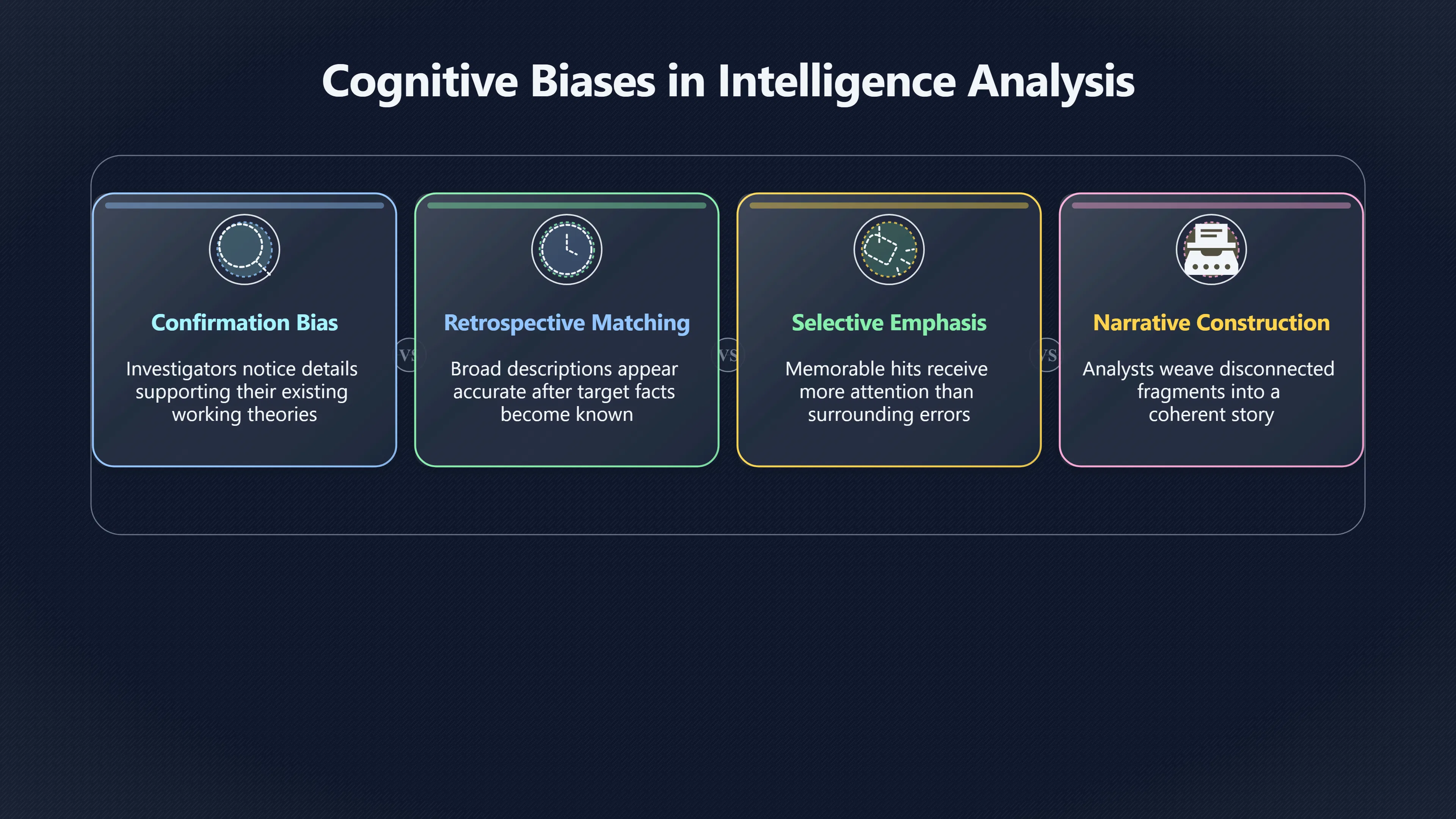
- Confirmation bias: Investigators may notice details supporting their working theory while discounting contradictions.
- Retrospective matching: After a target becomes known, broad descriptions can appear surprisingly accurate because many interpretations become available.
- Selective emphasis: Particularly memorable “hits” receive greater attention than the numerous incorrect or irrelevant statements surrounding them.
- Narrative construction: Analysts may unconsciously weave disconnected fragments into a coherent story that the original report did not actually establish.
These are well-recognised cognitive challenges in intelligence analysis generally. Their impact becomes greater when source reliability cannot be quantified and when reports require extensive subjective interpretation before becoming operationally meaningful.
The AIR reviewers found that remote-viewing products typically required exactly this kind of interpretation. Rather than providing directly verifiable intelligence, they often offered impressions whose meaning depended heavily on the analyst reading them.[CIA]cia.govAN EVALUATION OF THE REMOTE VIEWING PROGRAMIn no case had the information provided ever been used to guide intelligence operations. Th…
The Operational Cost of Chasing Weak Leads
Every intelligence investigation consumes finite resources.
Following a potentially valuable lead may involve:
- assigning surveillance personnel;
- diverting technical collection assets;
- reviewing imagery or communications;
- conducting interviews or field investigations;
- delaying work on competing priorities.
If the underlying information proves unreliable, these costs cannot be recovered.
Importantly, the operational loss is not limited to wasted effort. Pursuing one weak lead may mean failing to investigate another, stronger source within the same time window. Intelligence organisations therefore judge information not simply by whether parts of it appear interesting, but by whether it improves decision quality enough to justify the resources spent acting upon it.
The AIR evaluation reported that end users did not regard remote-viewing reports as providing sufficient operational value despite occasional apparently interesting elements. Reviewers concluded that the information was better suited to describing broad characteristics than producing the concrete details required for intelligence collection or operational planning.[CIA]cia.govAN EVALUATION OF THE REMOTE VIEWING PROGRAMIn no case had the information provided ever been used to guide intelligence operations. Th…
Why Partial Success Can Still Produce Failure
Supporters of remote viewing have sometimes highlighted individual cases that appear unusually successful. Even if isolated reports seem impressive, intelligence systems must evaluate the overall reliability of a collection method rather than memorable anecdotes.
From an operational perspective, occasional correct observations do not necessarily offset frequent irrelevant material. If analysts cannot identify beforehand which reports are dependable, then every report carries uncertainty requiring independent verification.
The result is an unfavourable signal-to-noise ratio. Valuable information, if present at all, becomes buried among descriptions that are inaccurate, too general or unrelated to the target. Historical programme documents themselves occasionally acknowledged concerns about this problem, referring to less-than-ideal signal-to-noise characteristics and recognising that useful observations were often accompanied by substantial extraneous material.[CIA]cia.govSTARGATE - PROGRAM STATUS, PROPOSED OPTIONSUnless there are new facts uncovered by the AIR review, I believe they will conclude (as di…
This distinction explains why isolated successes cannot by themselves demonstrate operational usefulness. Intelligence collection methods must consistently reduce uncertainty rather than simply produce occasional striking coincidences.

Lessons for Intelligence Evaluation
The experience of remote viewing reinforced several principles that extend well beyond paranormal claims.
Operational intelligence benefits from sources that:[Wikipedia]WikipediaRemote viewingRemote viewingThe program ran from 1975 to 1995 and ended after evaluators concluded that remote viewers consistently failed to produc…
- have measurable reliability;
- produce specific, testable information;[cia.gov]cia.govAN EVALUATION OF THE REMOTE VIEWING PROGRAMIn no case had the information provided ever been used to guide intelligence operations. Th…
- minimise irrelevant detail;
- support independent corroboration;
- allow analysts to estimate confidence before acting.
Conversely, sources producing mixtures of accurate and inaccurate material create persistent decision problems. Analysts must spend additional effort separating possible signal from noise while remaining vulnerable to cognitive bias and retrospective interpretation.
The official assessment of the Star Gate programme ultimately judged this trade-off unfavourable. Although laboratory debates about anomalous cognition continued, reviewers concluded that remote-viewing reports had not demonstrated the consistency or operational clarity necessary to justify directing intelligence resources. Reports containing wrong or irrelevant clues risked leading investigators into precisely the kind of blind alleys that intelligence collection seeks to avoid.[CIA]cia.govAN EVALUATION OF THE REMOTE VIEWING PROGRAMIn no case had the information provided ever been used to guide intelligence operations. Th…

eBay marketplace picks
Marketplace Samples
Example marketplace items related to this page. Use the search link to explore similar finds on eBay.



Endnotes
1.
Source: cia.gov
Link:https://www.cia.gov/readingroom/docs/CIA-RDP96-00791R000200180005-5.pdf
Source snippet
AN EVALUATION OF THE REMOTE VIEWING PROGRAMIn no case had the information provided ever been used to guide intelligence operations. Th...
2.
Source: cia.gov
Link:https://www.cia.gov/readingroom/docs/CIA-RDP96-00791R000100160003-8.pdf
Source snippet
STARGATE - PROGRAM STATUS, PROPOSED OPTIONSUnless there are new facts uncovered by the AIR review, I believe they will conclude (as di...
3.
Source: Wikipedia
Title: Remote viewing
Link:https://en.wikipedia.org/wiki/Remote_viewing
Source snippet
Remote viewingThe program ran from 1975 to 1995 and ended after evaluators concluded that remote viewers consistently failed to produc...
Additional References
4.
Source: researchgate.net
Link:https://www.researchgate.net/publication/403178755_The_Star_Gate_Archives_Reports_of_the_United_States_Government_Sponsored_Psi_Program_1972-1995_Volume_4_Operational_Remote_Viewing_Memorandums_and_Reports
Source snippet
inaccurate information”. (p. 330). Later, a request from Congressman Edward. Boland made the DIA assemble a team to make an inde-. penden...
5.
Source: greydynamics.com
Link:https://greydynamics.com/intelligence-past-the-tangible-world-cias-[stargate
Source snippet
In 1995, the CIA contracted the American Institute for Research (AIR) to evaluate the Stargate Program.Read more...
6.
Source: academia.edu
Title: (PDF) The Star Gate Operational Remote Viewing Program
Link:https://www.academia.edu/95285973/The_Star_Gate_Operational_Remote_Viewing_Program_A_Human_Intelligence_HUMINT_Collection_Platform
Source snippet
remote viewing produced no accurate or actionable intelligence, the evaluation was not redacted. However, there are several government re...
7.
Source: Wikipedia
Title: Stargate Project (U.S. Army unit)
Link:https://en.wikipedia.org/wiki/Stargate_Project_%28U.S._Army_unit%29
Source snippet
Stargate Project (U.S. Army unit)According to the AIR review, no remote viewing report ever provided actionable information for any in...
8.
Source: youtube.com
Title: Inside The Military’s Secret Psychic Unit
Link:https://www.youtube.com/watch?v=9nY3hu76SyU
Source snippet
Stargate Project: How Did the CIA Turn the Human Mind into a Weapon? directly details why the intelligence community abandoned the Starga...
9.
Source: facebook.com
Link:https://www.facebook.com/historyoasis/posts/from-1972-to-1995-the-united-states-military-invested-over-20-million-in-one-of-/790173214116954/
Source snippet
From 1972 to 1995, the United States military invested over...The final AIR report concluded that no remote viewing report ever provided...
10.
Source: pmc.ncbi.nlm.nih.gov
Link:https://pmc.ncbi.nlm.nih.gov/articles/PMC10275521/
Source snippet
Central Intelligence Agency's (CIA...by Á Escolà‐Gascón · 2023 · Cited by 10 — Programs addressed remote viewing (RV), that is, determin...
11.
Source: youtube.com
Title: Stargate’s Gatekeeper: DIA & Remote Viewing with Dale E. Graff
Link:https://www.youtube.com/watch?v=VRAsTmT_nQo
Source snippet
Stargate Project: How Did the CIA Turn the Human Mind into a Weapon?...
12.
Source: youtube.com
Title: Stargate Project: How Did the CIA Turn the Human Mind into a Weapon?
Link:https://www.youtube.com/watch?v=IDPlEXpzRoQ
Source snippet
Inside The Military's Secret Psychic Unit...
13.
Source: youtube.com
Title: Inside Operation Stargate: The CIA’s Psychic Spy Experiment
Link:https://www.youtube.com/watch?v=oasTnsLw_n8
Source snippet
Joe McMoneagle - CIA's Project Stargate | SRS #95...
Topic Tree