Within Anecdotes
Could a Stranger Pick the Target?
A transcript that convinces someone who knows the target may fail when a blind judge must identify the target without hints.
On this page
- The difference between recognition and identification
- Why insider knowledge inflates accuracy
- What blind evaluation tests better
Page outline Jump by section
Introduction
A remote-viewing transcript can seem remarkably convincing to someone who already knows the target. The crucial question, however, is whether that same transcript allows a person with no prior knowledge to identify the correct target from several alternatives. This distinction lies at the heart of why blind evaluation matters. A knowledgeable insider may recognise meaningful details after the fact, but recognition is not the same as demonstrating that the transcript contains enough specific information to identify the target independently. For that reason, the strongest remote-viewing research has relied on blind judging procedures, while many criticisms of the field focus on situations where judges or evaluators possessed information that could influence their interpretations.[National Security Archive]nsarchive2.gwu.eduNational Security ArchiveAn Evaluation of Remote Viewing: Research and…March 13, 2015 — by MD Mumford · 1995 · Cited by 76 — The resul…
Within the broader debate about why anecdotes feel more convincing than systematic evidence, blind judging provides one of the clearest safeguards against hindsight and subjective interpretation. Rather than asking whether a description seems impressive, it asks a more demanding question: could a stranger, given only the transcript and a set of possible targets, reliably choose the correct one?
Could a Stranger Pick the Target?
The difference between recognition and identification
Recognition is psychologically easy. Once someone knows that the target was, for example, a bridge, an industrial complex or a coastline, they naturally notice phrases that appear compatible with that knowledge. General descriptions such as “large structure”, “metal”, “water nearby” or “open space” suddenly acquire apparent precision because the target supplies the missing context.
Identification is a harder test. A blind judge receives the transcript without knowing which target is correct and must distinguish the intended target from several plausible alternatives. Success therefore depends on whether the transcript contains distinctive information rather than descriptions that could fit many locations or objects. This approach transforms an intuitive impression into a measurable decision.
Early Stanford Research Institute protocols adopted precisely this form of assessment by asking blind judges to match transcripts with target locations. The procedure attempted to separate genuine informational content from the persuasive power of hindsight.[National Security Archive]nsarchive2.gwu.eduNational Security ArchiveAn Evaluation of Remote Viewing: Research and…March 13, 2015 — by MD Mumford · 1995 · Cited by 76 — The resul…
The distinction matters because people often overestimate how specific a description really is after learning the answer. Cognitive psychology calls this hindsight bias: information that once seemed ambiguous appears obvious once the outcome is known. Blind judging is designed to prevent that effect from inflating apparent accuracy.
Why Insider Knowledge Can Inflate Accuracy
Someone familiar with the target possesses many opportunities—often unconscious—to construct coherent interpretations from incomplete material.
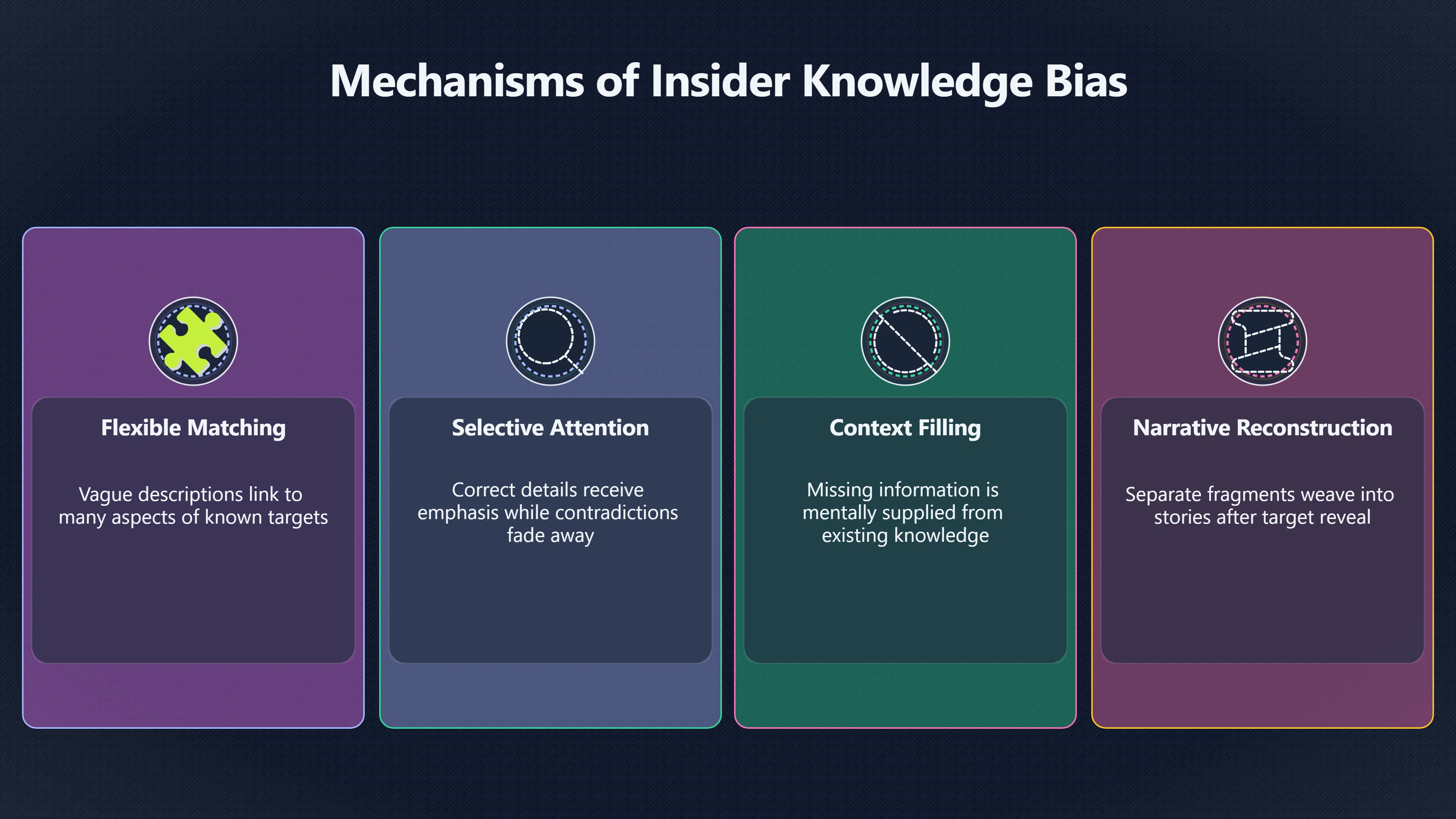
Several mechanisms contribute:
- Flexible matching. Vague descriptions can be linked to many aspects of the known target.
- Selective attention. Correct-looking details receive emphasis while incorrect or contradictory statements fade into the background.
- Context filling. Missing information is mentally supplied from existing knowledge, making the transcript appear richer than it actually is.
- Narrative reconstruction. Separate fragments become woven into a coherent story only after the target is revealed.
These influences do not necessarily involve deliberate bias. Even experienced evaluators can sincerely believe they are making objective judgements while unknowingly drawing on information unavailable to a genuinely blind assessor.
The American Institutes for Research review commissioned for the evaluation of the U.S. government’s Stargate programme highlighted this distinction. It noted that operational users sometimes found reports interesting or suggestive, yet emphasised that controlled experiments require blind judging because apparent usefulness can otherwise reflect subjective interpretation rather than demonstrable target identification. The review also warned that selectively reporting successful examples could exaggerate perceived performance.[National Security Archive]nsarchive2.gwu.eduNational Security ArchiveAn Evaluation of Remote Viewing: Research and…March 13, 2015 — by MD Mumford · 1995 · Cited by 76 — The resul…

What Blind Evaluation Tests Better
Blind judging does not ask whether a transcript is interesting. It asks whether it contains enough objective information to outperform chance under controlled conditions.
A typical blind protocol includes several safeguards:
- The judge does not know which target is correct.
- The transcript contains no identifying cues.
- The correct target is mixed with decoy targets.
- The judge ranks or selects the best match before learning the answer.
- Statistical analysis determines whether correct matches exceed chance expectations.
These procedures reduce opportunities for unconscious cueing, hindsight interpretation and confirmation bias. They also make different experiments easier to compare because the scoring method becomes explicit rather than impressionistic.[CIA]cia.govA REMOTE VIEWING EVALUATION PROTOCOL…In this procedure, a judge is presented with n RV transcripts and n target sites. His task is…
Importantly, blind judging evaluates the transcript itself rather than the charisma, reputation or confidence of the remote viewer. If the transcript consistently enables independent judges to identify the correct target, the evidence becomes stronger than simply collecting compelling anecdotes.
Why Blind Judging Became a Methodological Priority
Remote-viewing research evolved partly in response to criticism. Early experiments attracted methodological objections, including concerns that transcripts might contain subtle cues or that judges could infer answers from features unrelated to any claimed psychic perception.
The AIR review describes how critics pointed to potential sources of information leakage in early Stanford Research Institute experiments, including details embedded in transcripts and features of target selection procedures. Researchers subsequently introduced tighter protocols intended to eliminate these alternative explanations, with blind judging remaining one of the central safeguards.[National Security Archive]nsarchive2.gwu.eduNational Security ArchiveAn Evaluation of Remote Viewing: Research and…March 13, 2015 — by MD Mumford · 1995 · Cited by 76 — The resul…
Later discussions of SAIC experiments similarly examined whether anyone handling responses knew the target identity before judging, because even unintended cues from non-blind personnel could influence outcomes. Such debates illustrate that methodological credibility depends not only on statistical results but also on confidence that blind conditions were genuinely maintained.[Koestler Unit]koestlerunit.wordpress.comKoestler UnitExperiment One of the SAIC Remote Viewing Programby R Wiseman · Cited by 24 — receiver's responses should be blind to the id…
Blind Judges Do Not Resolve Every Dispute
Blind evaluation strengthens a study, but it does not settle the larger controversy over remote viewing.
Supporters argue that successful blind matching under controlled conditions provides evidence deserving further investigation, and recent meta-analyses continue to interpret the experimental literature as showing effects above chance.[ResearchGate]researchgate.net369604750 Remote Viewing a 1974 2022 systematic review and meta analysisResearchGate(PDF) Remote Viewing: a 1974-2022 systematic review…March 20, 2023 — This is the first meta-analysis of all studies relate…
Critics respond that blind judging addresses only one source of bias. They argue that broader questions remain about experimental design, replication, publication practices, statistical interpretation and alternative explanations for positive findings. Reviews commissioned by the U.S. government concluded that, regardless of some statistically interesting laboratory results, the evidence had not demonstrated reliable operational intelligence value.[National Security Archive]nsarchive2.gwu.eduNational Security ArchiveAn Evaluation of Remote Viewing: Research and…March 13, 2015 — by MD Mumford · 1995 · Cited by 76 — The resul…
The important point for evaluating individual claims is narrower than the overall debate. A transcript that impresses someone already familiar with the target provides weaker evidence than one that enables independent blind judges to identify the correct target under controlled conditions.
The Practical Lesson
When assessing remote-viewing claims, the identity of the evaluator matters almost as much as the transcript itself. An insider who already knows the answer is testing recognition, not independent identification. A blind judge, by contrast, asks whether the information stands on its own.
That distinction explains why compelling anecdotes often lose persuasive force under formal evaluation. Stories become stronger when people already know what happened. Scientific testing becomes stronger when the evaluator does not. In remote-viewing research, blind judging is therefore not a procedural detail but one of the primary safeguards separating subjective impressions from evidence that can be independently assessed.
Amazon book picks
Further Reading
Books and field guides related to Could a Stranger Pick the Target?. Use these as the next step if you want deeper reading beyond the article.
The elusive quarry
First published 1989. Subjects: Book reviews, Controversial literature, Parapsychology, Psychical research.
Parapsychology: A Handbook for the 21st Century
Explains judging procedures and methodology.
eBay marketplace picks
Marketplace Samples
Live-tested eBay searches with available results related to this page.
Endnotes
1.
Source: cia.gov
Link:https://www.cia.gov/readingroom/document/cia-rdp96-00788r001800080001-5
Source snippet
A REMOTE VIEWING EVALUATION PROTOCOL...In this procedure, a judge is presented with n RV transcripts and n target sites. His task is...
2.
Source: researchgate.net
Title: 369604750 Remote Viewing a 1974 2022 systematic review and [meta analysis]({{ ‘meta-analysis/’ | relative_url }})
Link:https://www.researchgate.net/publication/369604750_Remote_Viewing_a_1974-2022_systematic_review_and_meta-analysis
Source snippet
ResearchGate(PDF) Remote Viewing: a 1974-2022 systematic review...March 20, 2023 — This is the first meta-analysis of all studies relate...
Published: March 20, 2023
3.
Source: cia.gov
Link:https://www.cia.gov/readingroom/docs/CIA-RDP96-00791R000200180005-5.pdf
4.
Source: nsarchive2.gwu.edu
Link:https://nsarchive2.gwu.edu/NSAEBB/NSAEBB438/docs/doc_57.pdf
Source snippet
National Security ArchiveAn Evaluation of Remote Viewing: Research and...March 13, 2015 — by MD Mumford · 1995 · Cited by 76 — The resul...
Published: March 13, 2015
5.
Source: koestlerunit.wordpress.com
Link:https://koestlerunit.wordpress.com/wp-content/uploads/2015/06/wiseman-milton-1998.pdf
Source snippet
Koestler UnitExperiment One of the SAIC Remote Viewing Programby R Wiseman · Cited by 24 — receiver's responses should be blind to the id...
6.
Source: Wikipedia
Title: Remote viewing
Link:https://en.wikipedia.org/wiki/Remote_viewing
Source snippet
Remote viewingRemote viewing (RV) is the practice of seeking impressions about a distant or unseen subject, purportedly sensing with t...
Additional References
7.
Source: academia.edu
Link:https://www.academia.edu/Documents/in/associative_remote_viewing
Source snippet
associative remote viewing Research PapersAssociative remote viewing is a practice within parapsychology where individuals attempt to per...
8.
Source: pmc.ncbi.nlm.nih.gov
Title: PMCFollow‐up on the U.S
Link:https://pmc.ncbi.nlm.nih.gov/articles/PMC10275521/
Source snippet
Central Intelligence Agency's (CIA...by Á Escolà‐Gascón · 2023 · Cited by 10 — Since 1972, the U.S. Central Intelligence Agency (CIA) co...
9.
Source: youtube.com
Title: Single-Blind vs Double-Blind — What’s the Difference?
Link:http://www.youtube.com/watch?v=60_E23hElRc
Source snippet
Why blind experiments are important science methodology Double Blind Study Explained: How Blinded Experiments Work R3ciprocity.com-Prof D...
10.
Source: youtube.com
Title: Placebo Effect, Control Groups, and the Double Blind Experiment (3.2)
Link:http://www.youtube.com/watch?v=GMqrOdCx4Yg
Source snippet
How a Double-Blind Study Works in Science | Simply Explained...
11.
Source: youtube.com
Title: Double Blind Study Explained: How Blinded Experiments Work
Link:http://www.youtube.com/watch?v=ucYf_THd2_c
Source snippet
Placebo Effect, Control Groups, and the Double Blind Experiment (3.2)...
12.
Source: youtube.com
Title: How a Double-Blind Study Works in Science | Simply Explained
Link:http://www.youtube.com/watch?v=8B8S7v4LHZw
Source snippet
Understanding Double-Blind Studies: A Key to Scientific Research...
13.
Source: youtube.com
Title: Understanding Double-Blind Studies: A Key to Scientific Research
Link:http://www.youtube.com/watch?v=SbWajnwSoZU
Source snippet
Single-Blind vs Double-Blind — What’s the Difference?...
14.
Source: ciaotest.cc.columbia.edu
Title: sa jan02srm01
Link:https://ciaotest.cc.columbia.edu/olj/sa/sa_jan02srm01.html
Source snippet
Remote Viewing: The US Sponsored Psychic...This paper deals with experiments conducted in USA in which certain individuals were trained...
Topic Tree