Within SRI Tests
The Soviet Crane Claim Behind the Legend
The Soviet facility case became remote viewing folklore, but the declassified evaluations were far more cautious than the legend.
On this page
- What Price reportedly described
- Why the gantry crane became famous
- What later evaluations said about the case
Page outline Jump by section
Introduction
The URDF-3 case is one of the most frequently cited episodes in the history of remote viewing because it appeared to link a laboratory experiment with a genuine Cold War intelligence target. In 1974, psychic claimant Pat Price was asked to describe a Soviet installation known within the CIA as URDF-3 (Unidentified Research and Development Facility-3), located near the Semipalatinsk nuclear test complex in what is now Kazakhstan. His reported description of a distinctive gantry crane became a celebrated example among supporters of remote viewing, who argued that it anticipated features later confirmed by satellite imagery. Yet the declassified record presents a more complicated picture. While some elements of Price’s account resembled known features of the site, official technical reviews concluded that the session as a whole did not provide reliable intelligence and contained numerous inaccuracies. The famous crane survived in popular retellings, whereas the broader evaluation was far more cautious.
What Price reportedly described
Unlike many laboratory targets used in early Stanford Research Institute (SRI) experiments, URDF-3 was an operational intelligence target. Price was reportedly given only geographic coordinates, a map showing the approximate location, and the information that the target was a Soviet research and development facility. He was not told what kind of installation it was or what analysts believed might be taking place there.[Government Attic]governmentattic.orgPat Price's drawing of the gantry crane he remote viewed at the URDF-3.Read moreGovernment AtticThesis: Anomalous Human Cognition: A Possible Role…January 4, 2025 — 20 Sept 2023 — Beginning in February 1974, the SR…
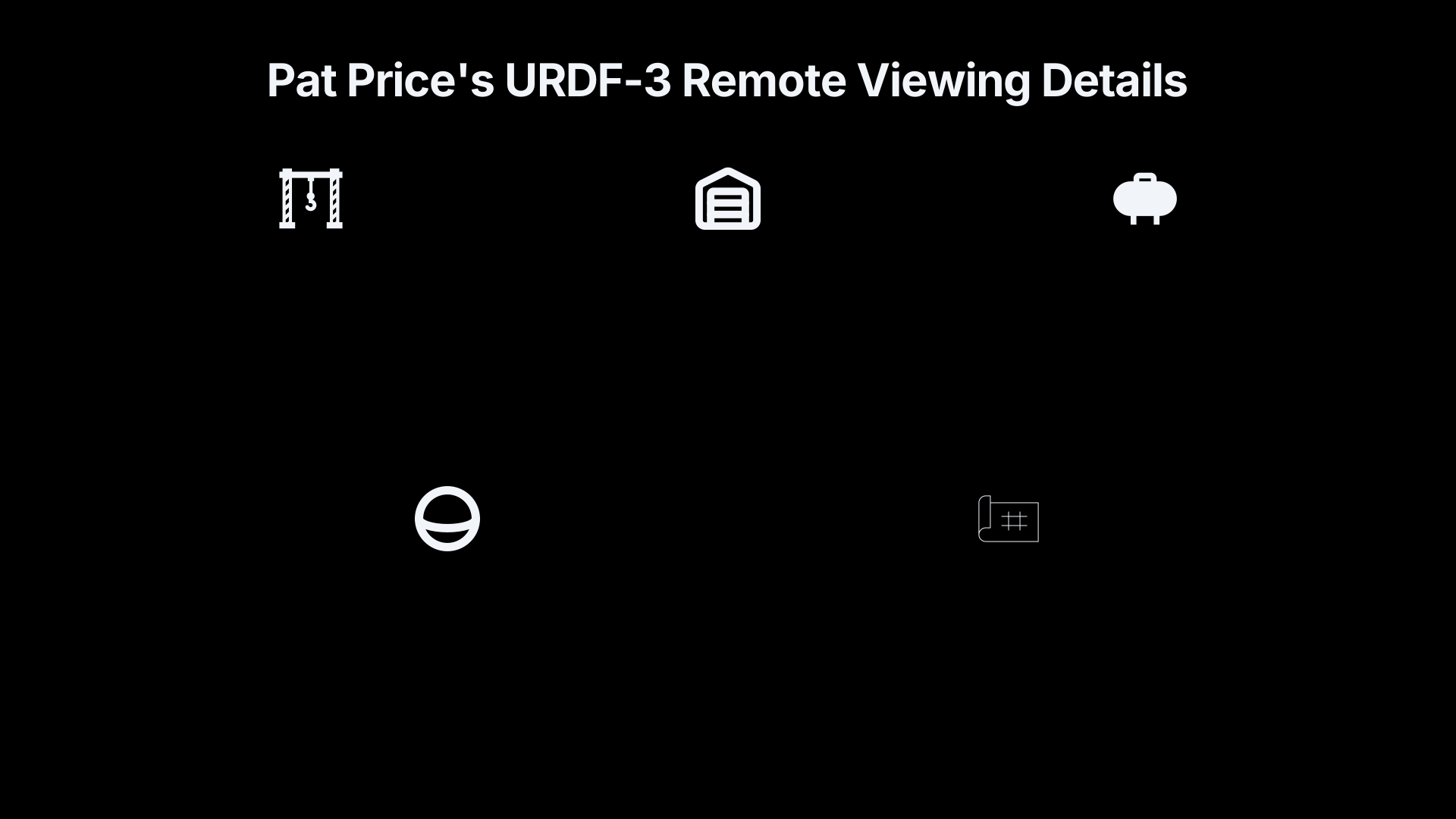
According to accounts by Harold Puthoff, Russell Targ and later participants in the programme, Price described himself as viewing a large industrial complex from above before giving increasingly detailed impressions of structures and activities within it. Among the most frequently quoted elements were:
- a massive gantry crane travelling on rails over a large building;
- a multi-storey industrial structure beneath the crane;
- large cylindrical tanks or pressure vessels;
- workers assembling a huge metal sphere from thick curved steel sections;
- technical problems involving distortion of the sphere during assembly.
Price also produced sketches of the crane arrangement, which later became central to the case’s reputation. Supporters argued that the crane’s unusual appearance reduced the likelihood that it had been guessed by chance.[Government Attic]governmentattic.orgPat Price's drawing of the gantry crane he remote viewed at the URDF-3.Read moreGovernment AtticThesis: Anomalous Human Cognition: A Possible Role…January 4, 2025 — 20 Sept 2023 — Beginning in February 1974, the SR…
Some later writers noted that years afterwards published reports on Soviet activities at Semipalatinsk referred to large steel spheres associated with nuclear testing research. These retrospective comparisons became part of the folklore surrounding the session, although they were not part of the original experimental verification.[Government Attic]governmentattic.orgPat Price's drawing of the gantry crane he remote viewed at the URDF-3.Read moreGovernment AtticThesis: Anomalous Human Cognition: A Possible Role…January 4, 2025 — 20 Sept 2023 — Beginning in February 1974, the SR…
Why the gantry crane became famous
The crane became the defining image of the URDF-3 story because satellite photography reportedly confirmed that the site contained an unusually large rail-mounted gantry spanning industrial buildings. CIA illustrations released decades later juxtaposed satellite-derived drawings with Price’s sketches, making the visual comparison especially striking.[Government Attic]governmentattic.orgPat Price's drawing of the gantry crane he remote viewed at the URDF-3.Read moreGovernment AtticThesis: Anomalous Human Cognition: A Possible Role…January 4, 2025 — 20 Sept 2023 — Beginning in February 1974, the SR…
Within the early SRI programme, this apparent correspondence was interpreted by some project participants as evidence that Price had perceived genuine target information. Former CIA officer Kenneth Kress later described the crane as one of several identifiable features that investigators deliberately used as partial validation markers. If Price correctly identified such distinctive structures, they believed it justified collecting additional intelligence-related descriptions.[scribd.com]scribd.comCIA RDP88G01116R000600690003 8PDFFirst, we needed assurance the channel was collecting useful data. I reviewed the photos of URDF-3 and chose two features which, if Pr…
The dramatic Cold War setting amplified the story. Rather than describing an ordinary local landmark, Price appeared to be describing a restricted Soviet installation associated with nuclear research. As the remote viewing programme later became publicly associated with CIA and Defence Intelligence Agency projects, the crane illustration became an enduring symbol of alleged psychic intelligence collection.
Over time, however, many popular retellings compressed the story into a simple claim that “Price accurately described a secret Soviet facility.” That summary omits the extensive debate over which details matched known information, which did not, and how success should be measured in an intelligence context.
What later evaluations said about the case
The most important corrective to the legend came from later technical reviews based on the complete session rather than its best-known highlights.
A declassified analysis conducted after comparison with satellite imagery concluded that the remote-viewing experiment was unsuccessful overall. Reviewers found that although Price appeared to identify the prominent gantry crane, many additional reported structures, activities and details could not be verified and several were contradicted by available imagery. The report therefore judged the session a failure rather than an operational success.[CIA]cia.govexperiment of urdf-3The remote-viewing experiment of URDF-3 by Pat Price proved to be unsuc- cessful. This conclusion was reached only…
One later summary of the evaluation notes that Price correctly mentioned the crane but also described numerous other objects that investigators could not confirm. The official assessment therefore weighed the complete body of information rather than selecting only the most impressive correspondence.[Encyclopedia.com]encyclopedia.compseudoscience intelligence studiesAccording to the Los Alamos report, from December 1975, "the validity of Price's remote viewing of URDF-3 appears to be a failure." Years…
This distinction illustrates an important issue in evaluating remote-viewing claims. Individual accurate-looking details may appear compelling, especially when they involve unusual structures, but intelligence analysis requires judging the entire information package. A report containing one striking match alongside many incorrect assertions may have little practical value because analysts cannot know in advance which statements are reliable.
Why the URDF-3 story remains debated
URDF-3 continues to occupy a distinctive place in discussions of remote viewing because both supporters and sceptics can point to genuine features of the historical record.
Supporters emphasise that:
- Price reportedly described an unusual crane before being shown imagery.
- Some physical features appeared to resemble later satellite interpretations.
- The case helped convince intelligence officials that further investigation into remote viewing was worthwhile.[Government Attic]governmentattic.orgPat Price's drawing of the gantry crane he remote viewed at the URDF-3.Read moreGovernment AtticThesis: Anomalous Human Cognition: A Possible Role…January 4, 2025 — 20 Sept 2023 — Beginning in February 1974, the SR…
Critics emphasise that:
- official evaluators judged the experiment unsuccessful overall;
- many reported observations were inaccurate or unverifiable;
- later retellings often highlighted successful-looking details while omitting the broader assessment.[CIA+2CIA]cia.govexperiment of urdf-3The remote-viewing experiment of URDF-3 by Pat Price proved to be unsuc- cessful. This conclusion was reached only…
The case therefore illustrates a recurring pattern in the history of remote viewing. Memorable correspondences—especially visually distinctive ones such as the gantry crane—can dominate public memory, while the less dramatic but methodologically important evaluations receive far less attention.

The significance of the Soviet crane claim
Within the wider history of SRI remote-viewing experiments, URDF-3 is best understood not as definitive proof or definitive disproof, but as an example of how intelligence agencies grappled with extraordinary claims during the Cold War. The crane sketch became an enduring icon because it appeared to provide a concrete, visual correspondence with a secret installation. Yet the declassified technical reviews show that government analysts ultimately evaluated the entire session rather than its strongest individual hit.
For that reason, the Soviet crane claim remains historically important less because it settled the question of remote viewing than because it demonstrates how striking anecdotes can acquire legendary status even when the original official assessments were considerably more restrained.
Amazon book picks
Further Reading
Books and field guides related to The Soviet Crane Claim Behind the Legend. Use these as the next step if you want deeper reading beyond the article.
The Reality of ESP: A Physicist's Proof of Psychic Abilities
Covers evidence and famous intelligence-related examples.
The seventh sense
Shows how intelligence remote viewing was presented by participants.
Mind-Reach
Discusses early SRI experiments including famous intelligence-related claims.
Reading the Enemy's Mind : Inside Star Gate
Provides insider context on operational remote viewing and its history.
eBay marketplace picks
Marketplace Samples
Live-tested eBay searches with available results related to this page.


Endnotes
1.
Source: scribd.com
Title: CIA RDP88G01116R000600690003 8
Link:https://www.scribd.com/document/660772883/CIA-RDP88G01116R000600690003-8
Source snippet
PDFFirst, we needed assurance the channel was collecting useful data. I reviewed the photos of URDF-3 and chose two features which, if Pr...
2.
Source: cia.gov
Link:https://www.cia.gov/readingroom/docs/CIA-RDP96-00791R000200240001-0.pdf
Source snippet
experiment of urdf-3The remote-viewing experiment of URDF-3 by [Pat Price]({{ 'pat-price/' | relative_url }}) proved to be unsuc- cessful. This conclusion was reached only...
3.
Source: cia.gov
Link:https://www.cia.gov/readingroom/document/cia-rdp96-00791r000200240001-0
Source snippet
conclusion was reached only after a careful review of the tape...Read more...
4.
Source: encyclopedia.com
Title: pseudoscience intelligence studies
Link:https://www.encyclopedia.com/politics/encyclopedias-almanacs-transcripts-and-maps/pseudoscience-intelligence-studies
Source snippet
According to the Los Alamos report, from December 1975, "the validity of Price's remote viewing of URDF-3 appears to be a failure." Years...
Published: December 1975
5.
Source: governmentattic.org
Title: Pat Price’s drawing of the gantry crane he remote viewed at the URDF-3.Read more
Link:https://www.governmentattic.org/57docs/ThesisAnomalousHumanCognition2023.pdf
Source snippet
Government AtticThesis: Anomalous Human Cognition: A Possible Role...January 4, 2025 — 20 Sept 2023 — Beginning in February 1974, the SR...
Published: January 4, 2025
Additional References
6.
Source: facebook.com
Link:https://www.facebook.com/100090372200308/posts/during-the-cold-war-the-cia-funded-research-into-what-they-called-remote-viewing/937678002587931/
Source snippet
rked with the approximate location of URDF-3, and told it was a...Read more...
7.
Source: reddit.com
Link:https://www.reddit.com/r/HighStrangeness/comments/1kossga/pat_price_remote_viewer/
Source snippet
Pat Price, Remote Viewer: r/HighStrangenessPrice reportedly claimed to have seen extraterrestrial structures during his remote viewing s...
8.
Source: pmc.ncbi.nlm.nih.gov
Link:https://pmc.ncbi.nlm.nih.gov/articles/PMC10275521/
Source snippet
Central Intelligence Agency's (CIA...by Á Escolà‐Gascón · 2023 · Cited by 10 — Since 1972, the U.S. Central Intelligence Agency (CIA) co...
9.
Source: ciaotest.cc.columbia.edu
Title: sa jan02srm01
Link:https://ciaotest.cc.columbia.edu/olj/sa/sa_jan02srm01.html
Source snippet
Remote Viewing: The US Sponsored Psychic...This paper deals with experiments conducted in USA in which certain individuals were trained...
10.
Source: nsarchive2.gwu.edu
Title: DIA 21
Link:https://nsarchive2.gwu.edu/NSAEBB/NSAEBB534-DIA-Declassified-Sourcebook/documents/DIA-21.pdf
Source snippet
STREAKUSING SEVERAL APPARENTLY GIFTED PSY HIC SUS3ECTS, THE MOST. NOTAELE OF WHOM WERE PAT PRICE AND iNGO SWANN, SRI. SCIENTISTS CONDUCTE...
11.
Source: youtube.com
Title: [Third Eye Spies]({{ ‘third-eye-spies/’ | relative_url }}) with Russell Targ
Link:https://www.youtube.com/watch?v=k9AsG1iNAyc
Source snippet
Scientific and Spiritual Implications of Psychic Abilities - Russell Targ...
12.
Source: youtube.com
Title: Scientific and Spiritual Implications of Psychic Abilities
Link:https://www.youtube.com/watch?v=zgyYms376Mg
Source snippet
Mind and Matter with Russell Targ...
13.
Source: youtube.com
Link:https://www.youtube.com/watch?v=XWqh9F4pjHg
Source snippet
Third Eye Spies with Russell Targ...
14.
Source: youtube.com
Title: Mind and Matter with Russell Targ
Link:https://www.youtube.com/watch?v=EhZ_ty3f4-M
Source snippet
[Precognition]({{ 'precognition/' | relative_url }}) with Russell Targ...
15.
Source: youtube.com
Title: Precognition with Russell Targ
Link:https://www.youtube.com/watch?v=KdhkuPLJYNA
Topic Tree