Within Protocol
The Moment Beginners Most Often Fool Themselves
Feedback helps learning only when the blind record is finished, saved and kept separate from later interpretation.
On this page
- Why feedback must wait until recording ends
- How post feedback additions should be labelled
- Preserving originals before polishing summaries
Page outline Jump by section
Introduction
In a beginner remote viewing protocol, the session is not complete when the viewer stops writing. It is complete only after the original record has been finished, saved and kept separate from everything that happens after the target is revealed. This moment is where many otherwise careful practice sessions become difficult to evaluate. Once feedback is available, memory changes rapidly, vague impressions acquire new meaning, and it becomes surprisingly easy to remember having written more than was actually recorded.
For that reason, both proponents of structured remote viewing and methodological critics emphasise the importance of preserving a blind record before any discussion, interpretation or scoring begins. Regardless of whether one believes remote viewing reflects a genuine phenomenon, keeping the original session intact is essential if later comparisons are to be meaningful.[National Security Archive+2CIA]nsarchive2.gwu.edudoc 57National Security ArchiveAn Evaluation of Remote Viewing: Research and…by MD Mumford · 1995 · Cited by 76 — New paradigms have been de…
Why feedback must wait until recording ends
Feedback is valuable because it lets a viewer compare expectations with reality. However, it only serves that purpose if it comes after every note, sketch and impression has already been recorded.
The reason is not unique to remote viewing. Psychology has long documented hindsight bias, sometimes called the “knew-it-all-along” effect. After learning an outcome, people routinely overestimate how predictable it seemed beforehand and unintentionally reconstruct their earlier beliefs to fit the new information. Outcome feedback can therefore improve learning while simultaneously making people less accurate at remembering what they originally thought.[Carnegie Mellon University+2MPG.PuRe]cmu.eduCarnegie Mellon University Outcome Feedback: Hindsight and InformationCarnegie Mellon UniversityOutcome Feedback: Hindsight and InformationOctober 8, 2004 — by SJ Hoch · 1989 · Cited by 247 — Although "hinds…
In remote viewing practice this creates a familiar pattern:
- a vague sketch begins to resemble the revealed target;
- an ambiguous word is mentally reinterpreted as something more specific;
- forgotten misses receive less attention than apparent hits;
- later summaries become more confident than the original notes justify.
None of these changes necessarily involve dishonesty. They are ordinary features of human memory. The protocol exists precisely because sincere observers are vulnerable to them.
This is one reason formal remote viewing studies have relied on blind recording followed by later judging, rather than allowing viewers to revise their session after learning the target. Independent judging and preserved transcripts are intended to separate original perceptions from later interpretation.[Koestler Parapsychology Unit+2National Security Archive]koestler-parapsychology.psy.ed.ac.ukKPU 1034 Published ResultsKoestler Parapsychology UnitAssociative remote viewing projects: Assessing rater…by DL KATZ · 2021 · Cited by 10 — Using double-blind…
The moment beginners most often fool themselves
The reveal stage often feels like the most exciting part of a session. Unfortunately, it is also the easiest point at which the quality of evidence declines.
Imagine a viewer has written:
- “cold”
- “vertical”
- “bright”
- a rough zig-zag sketch
The target turns out to be a waterfall.
After seeing the photograph, the viewer may sincerely feel that the zig-zag “obviously” represented flowing water and that “bright” referred to sunlight reflecting on the falls. Yet before feedback, those same notes might equally have matched a staircase, a lightning bolt, an icy mountain or many other scenes.
The danger is not that interpretation is forbidden. Interpretation is unavoidable. The problem arises when later interpretation becomes indistinguishable from the original blind record.
Critics of remote viewing have repeatedly argued that generous matching and flexible interpretation can inflate apparent success, particularly when transcripts are ambiguous or judges know which target is correct. Supporters who advocate stricter protocols generally agree that stronger blinding and cleaner separation between session and evaluation produce more credible results.[CIA+2National Security Archive]cia.govAN EVALUATION OF THE REMOTE VIEWING PROGRAMUse of the same remote viewers, the same judge, and the same target photographs makes it im…
How post-feedback additions should be labelled
Feedback should begin a new stage rather than rewriting the old one.
A simple record-keeping policy makes this clear:
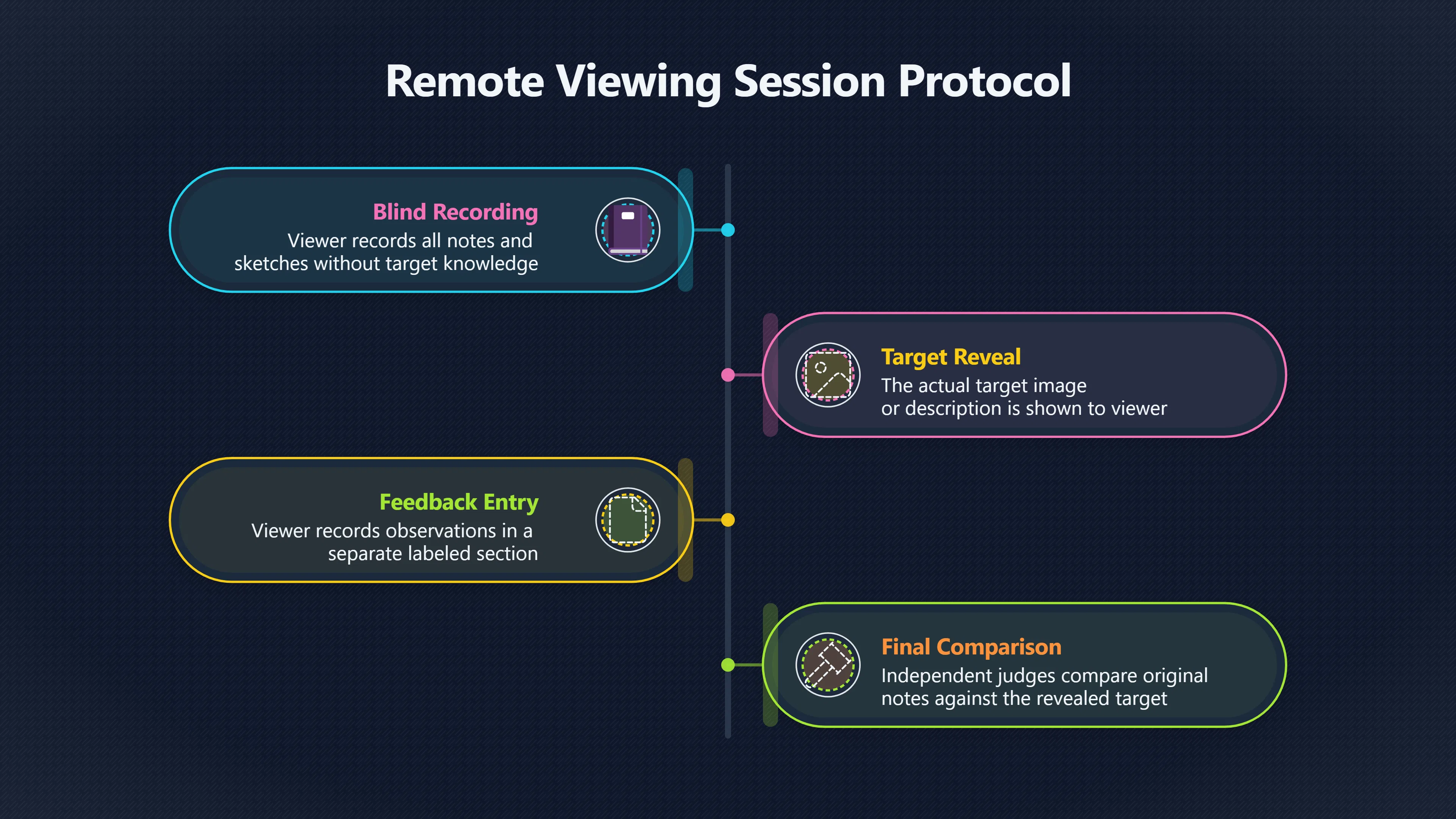
- Preserve the original session exactly as completed.
- Reveal the target.
- Start a clearly labelled feedback section.
- Record observations about similarities and differences separately from the original transcript.
For example:
Original session (blind):[koestler-parapsychology.psy.ed.ac.uk]koestler-parapsychology.psy.ed.ac.ukKPU 1034 Published ResultsKoestler Parapsychology UnitAssociative remote viewing projects: Assessing rater…by DL KATZ · 2021 · Cited by 10 — Using double-blind…
- “metal”
- “round”
- “movement”
Feedback notes (after reveal):
- “The target contained a ferris wheel.”
- “I think ‘round’ may relate to the wheel.”
- “‘Metal’ appears plausible.”
- “‘Movement’ could fit, although I did not mention height or amusement rides.”
This format keeps the historical record intact. Anyone reviewing the session later can distinguish between what existed before feedback and what was inferred afterwards.
Preserving originals before polishing summaries
Many viewers eventually write cleaner summaries of their sessions. That can be useful for reflection, provided the summary never replaces the original material.
Good practice includes:
- keeping dated handwritten pages or digital originals;
- photographing notebook pages before editing;
- storing scans or PDFs that cannot easily be altered;
- numbering pages so later insertions are obvious;
- writing summaries in a separate document rather than editing the transcript itself.
These habits are common safeguards in many forms of observational work because they preserve an audit trail. If questions arise later, reviewers can always return to the first record rather than relying on memory.
For beginners, the untidy first draft is usually more valuable than an elegant rewrite.
Why separating interpretation improves learning
Keeping blind records separate from feedback does more than strengthen credibility. It also improves practice.
When original notes remain untouched, viewers can identify recurring patterns such as:
- impressions that consistently prove unhelpful;
- descriptive styles that repeatedly match targets;
- habits of over-interpreting symbolic impressions;
- tendencies to replace sensory descriptions with guesses.
Because the comparison is honest, improvement becomes easier to measure. If every transcript is unconsciously rewritten after feedback, genuine progress becomes almost impossible to detect because the baseline keeps changing.
Research on hindsight bias similarly shows that people learn best when they can compare their genuine earlier judgement with the actual outcome instead of remembering a reconstructed version of what they “must have known.” Carnegie Mellon University+2Proceedings of Machine Learning Research[cmu.edu]cmu.eduCarnegie Mellon University Outcome Feedback: Hindsight and InformationCarnegie Mellon UniversityOutcome Feedback: Hindsight and InformationOctober 8, 2004 — by SJ Hoch · 1989 · Cited by 247 — Although "hinds…

A simple governance rule for beginner practice
A practical beginner policy can be expressed in one sentence:
Nothing recorded after feedback should ever be mistaken for data produced under blind conditions.
Applying this rule means treating the session as two separate documents:
- Blind record: everything created before the target is revealed.
- Feedback and analysis: every comparison, interpretation, confidence rating and lesson recorded afterwards.
This separation protects both supporters and sceptics from the same problem. Supporters gain cleaner evidence for evaluating their own performance, while critics can assess what was actually written without wondering whether later knowledge shaped the transcript. Regardless of one’s view of remote viewing itself, preserving that distinction is one of the simplest and most effective ways to reduce self-deception during beginner practice.
Amazon book picks
Further Reading
Books and field guides related to The Moment Beginners Most Often Fool Themselves. Use these as the next step if you want deeper reading beyond the article.
Thinking, Fast and Slow
Covers hindsight bias and cognitive errors relevant to preserving blind records.
The seventh sense
Explains structured remote viewing practice and disciplined recording.
eBay marketplace picks
Marketplace Samples
Live-tested eBay searches with available results related to this page.



Endnotes
1.
Source: cia.gov
Link:https://www.cia.gov/readingroom/docs/CIA-RDP96-00791R000200180005-5.pdf
Source snippet
AN EVALUATION OF THE REMOTE VIEWING PROGRAMUse of the same remote viewers, the same judge, and the same target photographs makes it im...
2.
Source: pure.mpg.de
Link:https://pure.mpg.de/rest/items/item_2102632_11/component/file_2102631/content
Source snippet
Bias: A By-Product of Knowledge Updating?by U Hoffrage · 2000 · Cited by 465 — Hindsight bias and the knew-it-all-along effect have been...
3.
Source: nsarchive2.gwu.edu
Title: doc 57
Link:https://nsarchive2.gwu.edu/NSAEBB/NSAEBB438/docs/doc_57.pdf
Source snippet
National Security ArchiveAn Evaluation of Remote Viewing: Research and...by MD Mumford · 1995 · Cited by 76 — New paradigms have been de...
4.
Source: cmu.edu
Title: Carnegie Mellon University Outcome Feedback: Hindsight and Information
Link:https://www.cmu.edu/dietrich/sds/docs/loewenstein/OutcomeFeedback.pdf
Source snippet
Carnegie Mellon UniversityOutcome Feedback: Hindsight and InformationOctober 8, 2004 — by SJ Hoch · 1989 · Cited by 247 — Although "hinds...
Published: October 8, 2004
5.
Source: koestler-parapsychology.psy.ed.ac.uk
Title: KPU 1034 Published Results
Link:https://www.koestler-parapsychology.psy.ed.ac.uk/Documents/KPU_1034_Published_Results.pdf
Source snippet
Koestler Parapsychology UnitAssociative remote viewing projects: Assessing rater...by DL KATZ · 2021 · Cited by 10 — Using double-blind...
6.
Source: journalofscientificexploration.org
Link:https://journalofscientificexploration.org/index.php/jse/article/view/3687
Source snippet
Experts' Remote Viewing Guidelines26 Mar 2026 — Experts also agreed on the importance of blinding procedures to prevent [contamination]({{ 'contamination/' | relative_url }}) of...
7.
Source: proceedings.mlr.press
Link:https://proceedings.mlr.press/v58/mahdavi17a/mahdavi17a.pdf
Source snippet
Proceedings of Machine Learning ResearchHindsight Bias Impedes Learningby S Mahdavi · 2016 · Cited by 10 — Hindsight bias has been shown...
8.
Source: Wikipedia
Title: Remote viewing
Link:https://en.wikipedia.org/wiki/Remote_viewing
Source snippet
Remote viewingRemote viewing (RV) is the practice of seeking impressions about a distant or unseen subject, purportedly sensing with t...
Additional References
9.
Source: thedecisionlab.com
Link:https://thedecisionlab.com/biases/hindsight-bias
Source snippet
Hindsight BiasHindsight bias, or the knew-it-all-along, is the tendency to claim currents events were to happen even though it was comple...
10.
Source: uni-muenster.de
Link:https://www.uni-muenster.de/PsyIFP.AENestler/research/hindsightbias.html
Source snippet
Hindsight Bias and the Accuracy of Personality JudgmentsAn integrative lens model approach to bias and accuracy in human inferences: Hind...
11.
Source: medium.com
Link:https://medium.com/remote-viewing-community-magazine/remote-viewing-definition-protocol-and-corollaries-dca159934230
Source snippet
Remote Viewing: definition, protocol, and corollariesRemote Viewing is required to be “double-blind”. That means there are two (double) l...
12.
Source: researchgate.net
Link:https://www.researchgate.net/figure/Showing-the-nine-phases-of-a-typical-ARV-protocol_tbl1_344470071
Source snippet
Showing the nine phases of a typical ARV protocolThis double-blind study utilised dreaming instead of remote viewing as a precognitive to...
13.
Source: academia.edu
Link:https://www.academia.edu/Documents/in/controlled_remote_viewing
Source snippet
controlled remote viewing Research PapersIt addresses training requirements, environmental setups, blinding protocols, feedback practices...
14.
Source: researchgate.net
Title: 369604750 Remote Viewing a 1974 2022 systematic review and [meta analysis]({{ ‘meta-analysis/’ | relative_url }})
Link:https://www.researchgate.net/publication/369604750_Remote_Viewing_a_1974-2022_systematic_review_and_meta-analysis
Source snippet
(PDF) Remote Viewing: a 1974-2022 systematic review...Associative Remote Viewing (ARV) is a psi-based methodology used by individuals an...
15.
Source: youtube.com
Link:https://www.youtube.com/watch?v=Smo1aP0v4xg
Source snippet
Principles of Remote Viewing with Paul H. SmithHere he describes the experimental protocols that distinguish remote viewing from other ty...
16.
Source: pmc.ncbi.nlm.nih.gov
Title: PMCHindsight Bias and Developing Theories of Mind
Link:https://pmc.ncbi.nlm.nih.gov/articles/PMC3649066/
Source snippet
Bias and Developing Theories of Mind - PMCby DM Bernstein · 2007 · Cited by 107 — The concepts of hindsight bias and ToM are related: bot...
17.
Source: scribd.com
Link:https://www.scribd.com/doc/80682670/CRVfull
Source snippet
dback provides critical closure to remote viewing sessions...Read more...
18.
Source: researchgate.net
Title: 403180890 Experts’ Remote Viewing Guidelines
Link:https://www.researchgate.net/publication/403180890_Experts%27_Remote_Viewing_Guidelines
Source snippet
(PDF) Experts' Remote Viewing Guidelines31 Mar 2026 — Experts also agreed on the importance of blinding procedures to prevent contaminati...
Topic Tree