Within Replication
What Happens to the Failed Sessions?
Hits become more meaningful only when misses, ambiguous sessions and null results are preserved in the same public record.
On this page
- Why selective reporting can reshape the evidence
- How misses and ambiguous trials should be logged
- What a trustworthy public record would include
Page outline Jump by section
Introduction
Transparent failure accounting means recording and reporting every remote-viewing session, not just the memorable successes. Within the debate over repeatability, this is one of the most important implementation issues because remote viewing produces subjective descriptions that can often be interpreted in multiple ways after the fact. If striking “hits” are publicised while ordinary misses, ambiguous transcripts and null experiments disappear, the apparent strength of the evidence can be exaggerated even when no deliberate misconduct has occurred.
This principle is not unique to remote viewing. Across psychology, medicine and other empirical sciences, selective reporting and publication bias are recognised threats to reliable knowledge. The question for remote-viewing research is therefore straightforward: can the public record be trusted to represent the full pattern of successes and failures, or does it mainly preserve the most persuasive stories?[MDPI]mdpi.comThe Weak Spots in Contemporary Science (and How to Fix…by JM Wicherts · 2017 · Cited by 74 — Several fraud cases, widespread failu…
Why selective reporting can reshape the evidence
Remote-viewing experiments usually generate a mixture of outcomes. Some sessions may appear surprisingly accurate, many contain vague or mixed impressions, and others fail entirely. Because the transcripts are often descriptive rather than numerical, later interpretation can become highly flexible. If only the most compelling examples are highlighted, readers may gain an inflated impression of consistency.
This creates several related problems:
- Memory bias: dramatic successes are easier to remember and circulate than routine failures.
- Publication bias: studies with positive findings are generally more likely to be published than studies reporting null results, a problem documented across many scientific disciplines.
- File-drawer effects: unsuccessful experiments may remain unpublished, making later reviews appear more favourable than the complete research record would justify.
- Post hoc interpretation: ambiguous descriptions can seem impressive after the target is known, especially if unsuccessful details receive little attention.[PMC+2MDPI]pmc.ncbi.nlm.nih.govPMCEnsuring the quality and specificity of preregistrationsby M Bakker · 2020 · Cited by 150 — Transparent reporting of these degrees of freedom can prevent common questionable research practic…
These concerns are especially relevant in remote viewing because scoring often depends on matching complex narratives with possible targets. A single impressive correspondence can overshadow numerous incorrect details unless the entire transcript and every trial remain available for independent inspection.
How misses and ambiguous trials should be logged
A transparent record does not require that every session succeed. Instead, it requires that every session be visible.
For each trial, a trustworthy protocol would preserve:
- the original transcript or sketches exactly as produced;
- the target assignment and randomisation procedure;
- the scoring rules specified before judging began;
- whether the session counted as a hit, miss or indeterminate result under those predefined rules;
- any excluded sessions together with the reason for exclusion;
- deviations from the planned protocol;
- the complete sequence of trials rather than selected examples.
Recording ambiguous outcomes is particularly important. Some sessions contain elements that partially resemble several possible targets. Rather than forcing a binary success-or-failure judgement after inspection, researchers should document the ambiguity itself and explain how the predefined scoring system handled it.
Likewise, failed sessions should not be discarded because they appear uninteresting. They establish the experiment’s baseline performance and allow later analysts to estimate whether apparent successes occur more often than expected by chance.
Why complete records matter more than impressive anecdotes
A collection of spectacular individual sessions cannot by itself demonstrate a repeatable phenomenon. Scientific evaluation depends on distributions rather than isolated examples.
For example, imagine a project reporting twenty striking remote-viewing successes. Without knowing:
- how many total sessions were conducted,
- how many failed completely,
- how many were only weakly suggestive,
- and whether unsuccessful series remained unpublished,
it is impossible to judge the true success rate.
This issue has appeared repeatedly in broader discussions of parapsychology. Critics have argued that selective publication could inflate apparent effect sizes, while proponents have responded by conducting publication-bias analyses within meta-analyses. Even where authors conclude that publication bias does not fully explain reported effects, the discussion itself illustrates why complete reporting remains essential rather than optional.[CIA+2ResearchGate]cia.govREPLICATION AND META-ANALYSIS IN…Each analysis included an overall summary, an analysis of the quality of the studies versus the si…
What a trustworthy public record would include
Modern transparency standards provide practical guidance that can be applied regardless of whether remote viewing ultimately proves genuine.
A robust public record would include:
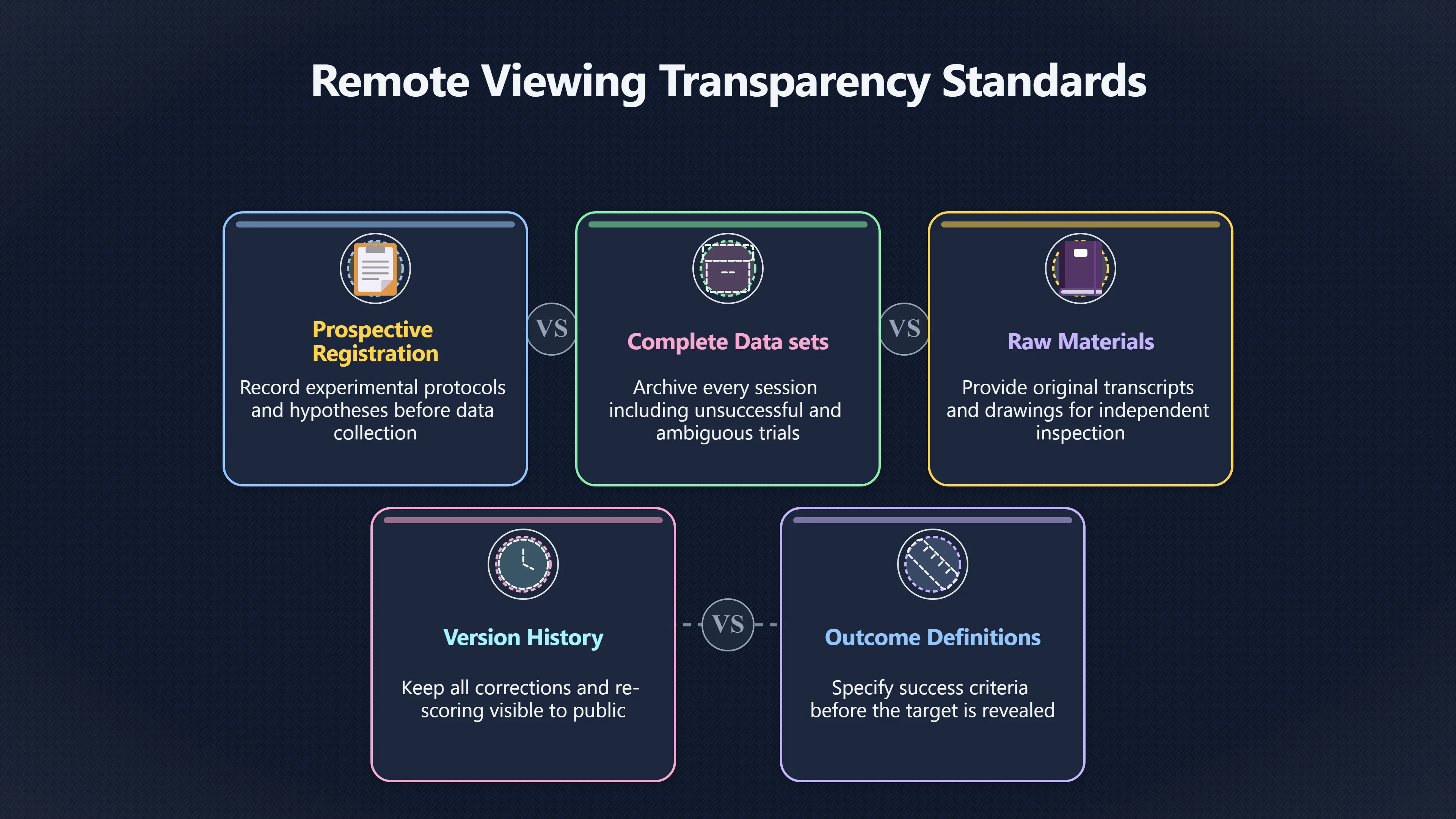
- Prospective registration. Experimental protocols, hypotheses and analysis plans should be recorded before data collection begins so readers can distinguish planned analyses from exploratory ones.
- Complete datasets. Every session should be archived, including unsuccessful and ambiguous trials.
- Raw materials. Original transcripts, drawings and scoring sheets should be available where ethics and privacy permit.
- Version history. Any corrections or re-scoring should remain visible rather than replacing earlier records.
- Independent reanalysis. Outside researchers should be able to reproduce published statistics from the underlying data.
- Clear outcome definitions. Success criteria should be specified before viewing sessions occur instead of being refined after the target is revealed.[PMC]pmc.ncbi.nlm.nih.govPMCEnsuring the quality and specificity of preregistrationsby M Bakker · 2020 · Cited by 150 — Transparent reporting of these degrees of freedom can prevent common questionable research practic…
These practices reduce opportunities for unconscious bias as much as deliberate manipulation. They also allow supporters and sceptics to evaluate identical evidence instead of relying on selectively presented summaries.
Lessons from the remote-viewing debate
The long-running debate surrounding remote viewing illustrates why transparent failure accounting has become a central issue rather than a procedural detail. Reviews commissioned after the U.S. government’s remote-viewing programme acknowledged that some laboratory findings appeared statistically interesting while also identifying methodological concerns and questioning whether the overall evidence demonstrated a reliable paranormal capability suitable for practical use. Among the broader concerns were judging methods, experimental controls and the interpretation of the complete body of evidence rather than isolated successes.[Alice]alice.id.tue.nlmumford rose goslin 1995An Evaluation of Remote Viewing: Research and…by MD Mumford · 1995 · Cited by 75 — Although parapsychological research has a long…
Later advocates have argued that newer studies employ stronger methods and have reported meta-analytic evidence they believe supports the phenomenon. Critics continue to emphasise that convincing resolution depends not simply on additional positive findings but on transparent reporting, independent replication and comprehensive accounting of unsuccessful results alongside successful ones.[ResearchGate]researchgate.net374881423 Remote Viewing A 1974 2022 Systematic Review and Meta AnalysisResearchGate(PDF) Remote Viewing: A 1974-2022 Systematic Review…Oct 26, 2023 — This is the first meta-analysis of all studies related…
Why failures strengthen rather than weaken credible research
Reporting failures is often viewed as damaging to a controversial claim, but scientifically it has the opposite effect. A complete record allows researchers to estimate true success rates, detect patterns that disappear under stricter controls, identify methodological improvements and distinguish genuine effects from statistical noise.
For remote viewing, transparent failure accounting is therefore not merely good administrative practice. It is one of the conditions that would allow the field to be evaluated against the same standards applied elsewhere in mainstream science. Without visible misses, ambiguous sessions and null results, even impressive successes become difficult to interpret because no one can determine whether they represent an exceptional pattern or simply the surviving highlights from a much larger collection of ordinary failures.
Amazon book picks
Further Reading
Books and field guides related to What Happens to the Failed Sessions?. Use these as the next step if you want deeper reading beyond the article.
Calling Bullshit: The Art of Skepticism in a Data-Driven World
Helps readers assess evidence and reporting quality.

eBay marketplace picks
Marketplace Samples
Live-tested eBay searches with available results related to this page.

Endnotes
1.
Source: mdpi.com
Link:https://www.mdpi.com/2076-2615/7/12/90
Source snippet
The Weak Spots in Contemporary Science (and How to Fix...by JM Wicherts · 2017 · Cited by 74 — Several fraud cases, widespread failu...
2.
Source: pmc.ncbi.nlm.nih.gov
Title: PMCEnsuring the quality and specificity of preregistrations
Link:https://pmc.ncbi.nlm.nih.gov/articles/PMC7725296/
Source snippet
by M Bakker · 2020 · Cited by 150 — Transparent reporting of these degrees of freedom can prevent common questionable research practic...
3.
Source: cia.gov
Link:https://www.cia.gov/readingroom/docs/CIA-RDP96-00792R000100130004-9.pdf
Source snippet
REPLICATION AND [META-ANALYSIS]({{ 'meta-analysis/' | relative_url }}) IN...Each analysis included an overall summary, an analysis of the quality of the studies versus the si...
4.
Source: researchgate.net
Title: 374881423 Remote Viewing A 1974 2022 Systematic Review and Meta Analysis
Link:https://www.researchgate.net/publication/374881423_Remote_Viewing_A_1974-2022_Systematic_Review_and_Meta-Analysis
Source snippet
ResearchGate(PDF) Remote Viewing: A 1974-2022 Systematic Review...Oct 26, 2023 — This is the first meta-analysis of all studies related...
5.
Source: pmc.ncbi.nlm.nih.gov
Link:https://pmc.ncbi.nlm.nih.gov/articles/PMC4856278/
Source snippet
for Questionable Research Practices in a Meta-Analysisby DJ Bierman · 2016 · Cited by 65 — We describe a method of quantifying the effect...
6.
Source: pmc.ncbi.nlm.nih.gov
Title: PMCPractical routes to preregistration: a guide to enhanced
Link:https://pmc.ncbi.nlm.nih.gov/articles/PMC12066951/
Source snippet
by RJ Binney · 2025 · Cited by 7 — There is no guarantee that a published study with a linked preregistration has been reviewed... pr...
7.
Source: cia.gov
Link:https://www.cia.gov/readingroom/docs/CIA-RDP96-00791R000200180005-5.pdf
Source snippet
ound characteristics, the remote viewing reports failed to produce.Read more...
8.
Source: cia.gov
Link:https://www.cia.gov/readingroom/docs/CIA-RDP96-00789R002200400001-3.pdf
Source snippet
RDP96-00789R002200400001-3this analysis produced two reports that outlined an improved remote viewing analysis technique and provided...
9.
Source: researchgate.net
Link:https://www.researchgate.net/publication/342108880_Study_Preregistration_An_Evaluation_of_a_Method_for_Transparent_Reporting
Source snippet
published literature contains elevated type I error rates, preregistered... bias, selective outcome reporting, and the scarcity of null...
10.
Source: youtube.com
Title: The Remote Viewing SCIENCE Nobody Talks About
Link:https://www.youtube.com/watch?v=olNuOZKCdRQ
Source snippet
Publication bias...
11.
Source: youtube.com
Title: Publication bias
Link:https://www.youtube.com/watch?v=58V-rWq2uE8
Source snippet
Ray Hyman - The Life of an Expert Skeptic, Part 1...
12.
Source: alice.id.tue.nl
Title: mumford rose goslin 1995
Link:https://www.alice.id.tue.nl/references/mumford-rose-goslin-1995.pdf
Source snippet
An Evaluation of Remote Viewing: Research and...by MD Mumford · 1995 · Cited by 75 — Although parapsychological research has a long...
Additional References
13.
Source: scribd.com
Link:https://www.scribd.com/document/796796037/2931-Article-Text-16677-1-10-20231025
Source snippet
Remote Viewing Meta-Analysis 1974-2022 | PDFRemote viewing; meta-analysis; clairvoyance; [precognition]({{ 'precognition/' | relative_url }}); extrasensory perception...
14.
Source: reddit.com
Link:https://www.reddit.com/r/remoteviewing/comments/1erdzyv/request_for_peerreviewed_articles_demonstrating/
Source snippet
drawer" effect calculations and other calculations. The...Read more...
15.
Source: arxiv.org
Link:https://arxiv.org/html/2601.04583v1
Source snippet
Contract execution can fail through reverts, which undo all state changes and return remaining gas to the caller.Read more...
16.
Source: youtube.com
Title: The Replication Crisis: Why Studies Fail and How Psychology Is Fixing Itself
Link:https://www.youtube.com/watch?v=YpizifCQ96Y
Source snippet
Remote Viewing and Statistical Validation...
17.
Source: tandfonline.com
Link:https://www.tandfonline.com/doi/full/10.1080/10408444.2025.2611827
Source snippet
Failure to present contradictory findings or to acknowledge credible null results...Read more...
18.
Source: ics.uci.edu
Title: Utts Stat Psi
Link:https://www.ics.uci.edu/~jutts/UttsStatPsi.pdf
Source snippet
and Meta-Analysis in Parapsychologyby J Utts · 1991 · Cited by 321 — Each analysis included an overall summary, an analysis of the qualit...
19.
Source: arxiv.org
Title: arXiv Publication bias and the canonization of false facts
Link:https://arxiv.org/abs/1609.00494
20.
Source: journalofscientificexploration.org
Link:https://journalofscientificexploration.org/index.php/jse/article/view/2931
Source snippet
This is the first meta-analysis of all studies related to remote-viewing tasks conducted up to December 2022.Read more...
Published: December 2022
21.
Source: youtube.com
Title: Remote Viewing and Statistical Validation
Link:https://www.youtube.com/watch?v=YrwAiU2g5RU
Source snippet
The Remote Viewing SCIENCE Nobody Talks About...
22.
Source: facebook.com
Title: What is your opinion on remote viewing?What is your opinion on remote viewing?
Link:https://www.facebook.com/groups/knowledge.group1/posts/751005211997835/
Topic Tree