Within Stargate
Why Did Intelligence Agencies Take This Seriously?
Cold War agencies funded remote viewing because even a small chance of success seemed worth testing against Soviet uncertainty.
On this page
- Soviet bloc fears and strategic surprise
- Low cost testing versus high stakes ignorance
- Why investigation did not equal belief
Page outline Jump by section
Introduction
Cold War intelligence agencies did not fund remote viewing because they had concluded that psychic spying was real. They funded it because they feared the consequences of being wrong if an adversary discovered an unconventional capability first. During the strategic competition between the United States and the Soviet Union, even ideas that appeared highly improbable could justify limited investigation when the potential military payoff seemed enormous and the financial cost of testing was relatively modest. This logic helps explain why programmes that later became known collectively as Stargate survived for more than two decades despite persistent controversy and mixed results. Official reviews show that investigation did not equal endorsement: agencies repeatedly asked whether remote viewing could provide usable intelligence, and ultimately concluded that it had not demonstrated sufficient operational value.[CIA]cia.govAN EVALUATION OF THE REMOTE VIEWING PROGRAMDuring. Star Gate's history, DIA pursued three basic program objectives: "Operations," usin…
Why Soviet Research Changed the Calculation
The strongest driver behind American interest was uncertainty about Soviet activities rather than confidence in psychic phenomena themselves.
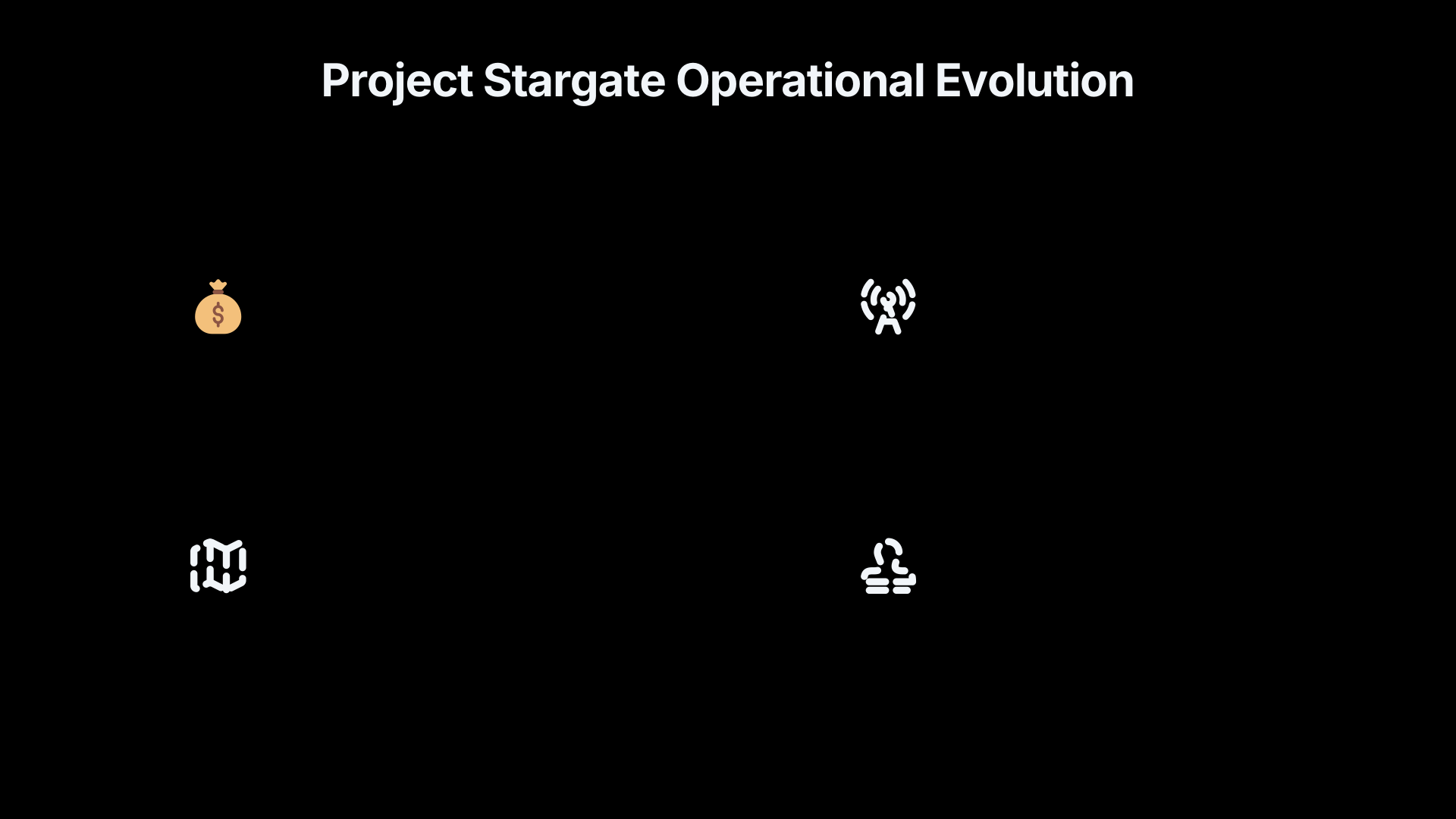
Throughout the 1970s, U.S. intelligence received reports that Soviet researchers were investing time and resources in areas broadly described as psychotronics and parapsychology. Some reports were exaggerated, while others reflected genuine Soviet research into unusual aspects of human performance. Intelligence officials could not easily determine how serious these efforts were or whether they might produce unexpected military applications. In an environment where strategic surprise was considered a major national-security risk, ignoring the subject entirely seemed imprudent.[The Guardian+2History]theguardian.comThe GuardianThe remote viewers | Science4 Jun 2003 — Project Stargate, a 23-year, $20m (£12m) programme of psychic spying, or remote view…
This reflected a familiar Cold War pattern. American agencies also investigated unconventional aircraft, advanced surveillance concepts and other speculative technologies because uncertainty itself carried strategic costs. Remote viewing became another example of this broader “hedging” strategy: officials preferred spending relatively small sums on research rather than risk overlooking something that an opponent might exploit.
Low-Cost Testing Versus High-Stakes Ignorance
The attraction of remote viewing lay less in the evidence supporting it than in the extraordinary intelligence advantage it promised if it proved genuine.
If someone could accurately describe distant military installations, locate hostages or identify hidden weapons without entering hostile territory, the implications would have been profound. Such a capability would avoid many of the risks associated with satellites, reconnaissance aircraft or human agents.
From a decision-maker’s perspective, the calculation looked asymmetric:
- The research budget represented only a tiny fraction of overall Cold War intelligence spending.
- Even a very small probability of success appeared worth investigating because the possible payoff was exceptionally large.
- Early laboratory findings, although disputed, appeared sufficiently intriguing to justify additional testing rather than immediate dismissal.
- Intelligence organisations routinely explored multiple speculative collection methods simultaneously, accepting that many would ultimately fail.[CIA+2CIA]cia.govAN EVALUATION OF THE REMOTE VIEWING PROGRAMDuring. Star Gate's history, DIA pursued three basic program objectives: "Operations," usin…
This logic resembles venture-style research rather than operational confidence. Agencies were effectively asking whether an unlikely possibility could become a practical intelligence tool, not assuming that it already had.
Investigation Was Not the Same as Belief
One of the most common misunderstandings about Stargate is that government funding proved intelligence agencies believed psychic spying worked.
The historical record suggests something more cautious. Programme documents show repeated efforts to evaluate, measure and validate claimed abilities under controlled conditions. Intelligence officials sought procedures that might distinguish genuine information from coincidence, educated guessing or unconscious cueing. The existence of testing therefore reflected institutional scepticism as much as institutional curiosity.[CIA]cia.govSTAR GATE PROJECT: AN OVERVIEW(U) This document provides a broad overview of the three main activity areas, (foreign assessment, exter…
Even when remote viewers participated in operational tasks, their reports were generally treated as supplementary material rather than decisive intelligence. Outputs were often compared with information from conventional collection methods instead of replacing them. This cautious handling indicates that many users regarded remote-viewing reports as exploratory leads rather than established evidence.
Why the Programme Continued Despite Mixed Results
Several factors helped sustain research beyond its initial experimental phase.
First, intelligence work rarely allows immediate yes-or-no answers. Because claimed successes were difficult to evaluate objectively, advocates argued that promising cases justified further study, while critics pointed to methodological weaknesses and inconsistent performance.
Second, secrecy limited outside scrutiny. Classified programmes naturally evolved more slowly because relatively few independent experts could assess their procedures or replicate findings.
Third, changes in sponsorship allowed the work to survive organisational transitions. Responsibility moved among different agencies and programmes under various code names, reflecting continuing interest in determining whether the reported effects could be made operationally reliable.[CIA]cia.govSTAR GATE PROJECT: AN OVERVIEW(U) This document provides a broad overview of the three main activity areas, (foreign assessment, exter…

What Finally Changed Official Thinking
By the mid-1990s, the strategic environment had shifted. The Cold War had ended, reducing the urgency that had originally justified many speculative intelligence projects.
The decisive question also changed. Instead of asking whether laboratory experiments showed statistically interesting effects, reviewers asked whether remote viewing had produced intelligence that commanders could depend upon in real-world operations.
The independent review commissioned by the CIA concluded that although some experimental findings remained subjects of debate, the programme had not generated intelligence of sufficient quality or consistency to justify continued operational use. Information was generally too vague, inconsistent or difficult to verify to support intelligence decisions. Consequently, the programme was terminated.[CIA]cia.govAN EVALUATION OF THE REMOTE VIEWING PROGRAMDuring. Star Gate's history, DIA pursued three basic program objectives: "Operations," usin…
The Cold War Lesson
The history of psychic spying illustrates less about belief in paranormal abilities than about how intelligence organisations manage uncertainty. During periods of intense geopolitical competition, agencies may investigate ideas with low prior probability when the potential consequences of overlooking a genuine capability appear exceptionally high.
Stargate therefore represents a Cold War insurance policy rather than proof that officials accepted psychic phenomena. The programme’s existence demonstrates a willingness to test extraordinary claims under government sponsorship, while its closure demonstrates that continued funding ultimately depended on practical intelligence value rather than curiosity alone.[CIA]cia.govAN EVALUATION OF THE REMOTE VIEWING PROGRAMDuring. Star Gate's history, DIA pursued three basic program objectives: "Operations," usin…
Amazon book picks
Further Reading
Books and field guides related to Why Did Intelligence Agencies Take This Seriously?. Use these as the next step if you want deeper reading beyond the article.
The Men Who Stare At Goats
Rating: 3.5/5 from 11 Google Books ratings
Illustrates military interest in unconventional ideas.

Remote Viewers: The Secret History of America's Psychic Spies
Explains why intelligence agencies persisted.
Phenomena
From the author of Nuclear War: A Scenario, this is the gripping story of how a select group of scientists, under the watchful eye of the...
eBay marketplace picks
Marketplace Samples
Live-tested eBay searches with available results related to this page.




Endnotes
1.
Source: cia.gov
Link:https://www.cia.gov/readingroom/docs/CIA-RDP96-00791R000200180005-5.pdf
Source snippet
AN EVALUATION OF THE REMOTE VIEWING PROGRAMDuring. Star Gate's history, DIA pursued three basic program objectives: "Operations," usin...
2.
Source: cia.gov
Link:https://www.cia.gov/readingroom/docs/CIA-RDP96-00789R002800180001-2.pdf
Source snippet
STAR GATE PROJECT: AN OVERVIEW(U) This document provides a broad overview of the three main activity areas, ([foreign assessment]({{ 'foreign-watch/' | relative_url }}), exter...
3.
Source: history.com
Title: cia esp espionage soviet union cold war
Link:https://www.history.com/articles/cia-esp-espionage-soviet-union-cold-war
Source snippet
The CIA Recruited 'Mind Readers' to Spy on the Soviets in...17 Oct 2018 — The CIA, Army and Defense Intelligence Agency recruited men an...
4.
Source: theguardian.com
Link:https://www.theguardian.com/science/2003/jun/05/research.science1
Source snippet
The GuardianThe remote viewers | Science4 Jun 2003 — Project Stargate, a 23-year, $20m (£12m) programme of psychic spying, or remote view...
5.
Source: Wikipedia
Title: Remote viewing
Link:https://en.wikipedia.org/wiki/Remote_viewing
Source snippet
Remote viewingThe AIR report concluded that no usable intelligence data was produced in the program.... no documented evidence it had...
Additional References
6.
Source: researchgate.net
Link:https://www.researchgate.net/publication/403178755_The_Star_Gate_Archives_Reports_of_the_United_States_Government_Sponsored_Psi_Program_1972-1995_Volume_4_Operational_Remote_Viewing_Memorandums_and_Reports
Source snippet
(1995). An. evaluation of remote viewing: Research and applications. American Institutes for Research. Mörck, N. C. (2018). Review of the...
7.
Source: reddit.com
Link:https://www.reddit.com/r/todayilearned/comments/1c08wm5/til_that_project_stargate_was_a_cia_plan_to_use/
Source snippet
TIL that Project Stargate was a CIA plan to use psychic...The project primarily focused on Remote Viewing and supposed ability to psychi...
8.
Source: medium.com
Link:https://medium.com/the-peculiar-truth/the-peculiar-truth-about-the-cias-project-stargate-61ac0534d2f4
Source snippet
The Peculiar Truth about the CIA's Project StargateMost of Project Stargate's assessments came with the caveat that remote viewing inform...
9.
Source: youtube.com
Title: Russell Targ
Link:https://www.youtube.com/watch?v=_sbkMlMobZE
Source snippet
I filtered the results to include only evergreen, public, English-language videos with live, embeddable YouTube watch links, prioritizing...
10.
Source: academia.edu
Link:https://www.academia.edu/95285973/The_Star_Gate_Operational_Remote_Viewing_Program_A_Human_Intelligence_HUMINT_Collection_Platform
Source snippet
Does the evidence indicate the presence of a statistically significant effect? · 2. Can the effects be attributed to paranormal phenomena...
11.
Source: reason.com
Title: The paranormal arms race between Russia and the U.S
Link:https://reason.com/2026/05/31/psychic-soldiers-mind-readers-and-dolphin-drones-the-cold-wars-weird-paranormal-history/
Source snippet
in...6 hours ago — The CIA Responds With Stargate Project 'Remote Viewing' Tests. At some point in the mid-20th century, knowledge of So...
12.
Source: Wikipedia
Title: Stargate Project (U.S. Army unit)
Link:https://en.wikipedia.org/wiki/Stargate_Project_%28U.S._Army_unit%29
Source snippet
Stargate Project (U.S. Army unit)The Stargate Project's work primarily involved remote viewing, the purported ability to psychically "...
13.
Source: youtube.com
Title: Scientific and Spiritual Implications of Psychic Abilities
Link:https://www.youtube.com/watch?v=zgyYms376Mg
Source snippet
"Russell Targ - Remote Viewing & Third Eye Spies[https://www.youtube.com/watch?v=E_cLp15CaPE..."](https://www.youtube.com/watch?v=E_cLp15CaPE...")...
14.
Source: scribd.com
Link:https://www.scribd.com/document/49106863/Project-SCANATE
Source snippet
Project SCANATE: CIA's Remote Viewing Origins | PDFThe CIA embarked on a project in 1972 to investigate psychic abilities and their poten...
15.
Source: youtube.com
Link:https://www.youtube.com/watch?v=9nY3hu76SyU
Source snippet
ocate hostages, uncover Soviet weapons, and spy...
Topic Tree