Within Marks Critique
Could Paperwork Explain the Hits?
Small details in remote-viewing transcripts could let judges match sessions to targets without any paranormal information.
On this page
- What counted as a cue
- How order and dates could help matching
- Why mundane clues mattered more than dramatic leaks
Page outline Jump by section
Introduction
One of the most influential criticisms of the early Stanford Research Institute (SRI) remote-viewing experiments did not centre on spectacular fraud or hidden communication. Instead, David Marks and Richard Kammann argued that the judging process itself may have contained ordinary clues that allowed transcripts to be matched with the correct targets. Their point was simple: if judges could infer which transcript belonged to which site from paperwork details rather than from the descriptions alone, then impressive scoring would not demonstrate paranormal perception. This criticism became a central methodological issue because remote-viewing experiments relied heavily on human judgement after the viewing session, making even subtle information leaks potentially important.[PubMed]pubmed.ncbi.nlm.nih.govNature. 1981 Jul 9;292(5819):177. doi: 10.1038/292177a0. Author. D Marks. PMID: 7242682; DOI: 10.1038…Read more…
Could Paperwork Explain the Hits?
The early SRI studies asked independent judges to compare free-response transcripts with a set of possible target locations. Unlike multiple-choice tests, these transcripts contained sketches, narrative impressions and incidental comments. Because many descriptions were broad enough to fit several locations, judges necessarily relied on interpretation when deciding which transcript matched which target.
Marks and Kammann argued that this interpretive process became vulnerable if the transcripts carried accidental identifying information. Their critique was not that every transcript contained an obvious giveaway, but that small pieces of contextual information could accumulate into a reliable pattern. Once a judge knew where a transcript belonged in the sequence of experiments, matching it to the corresponding target list became much easier.[PubMed]pubmed.ncbi.nlm.nih.govNature. 1981 Jul 9;292(5819):177. doi: 10.1038/292177a0. Author. D Marks. PMID: 7242682; DOI: 10.1038…Read more…
What counted as a cue?
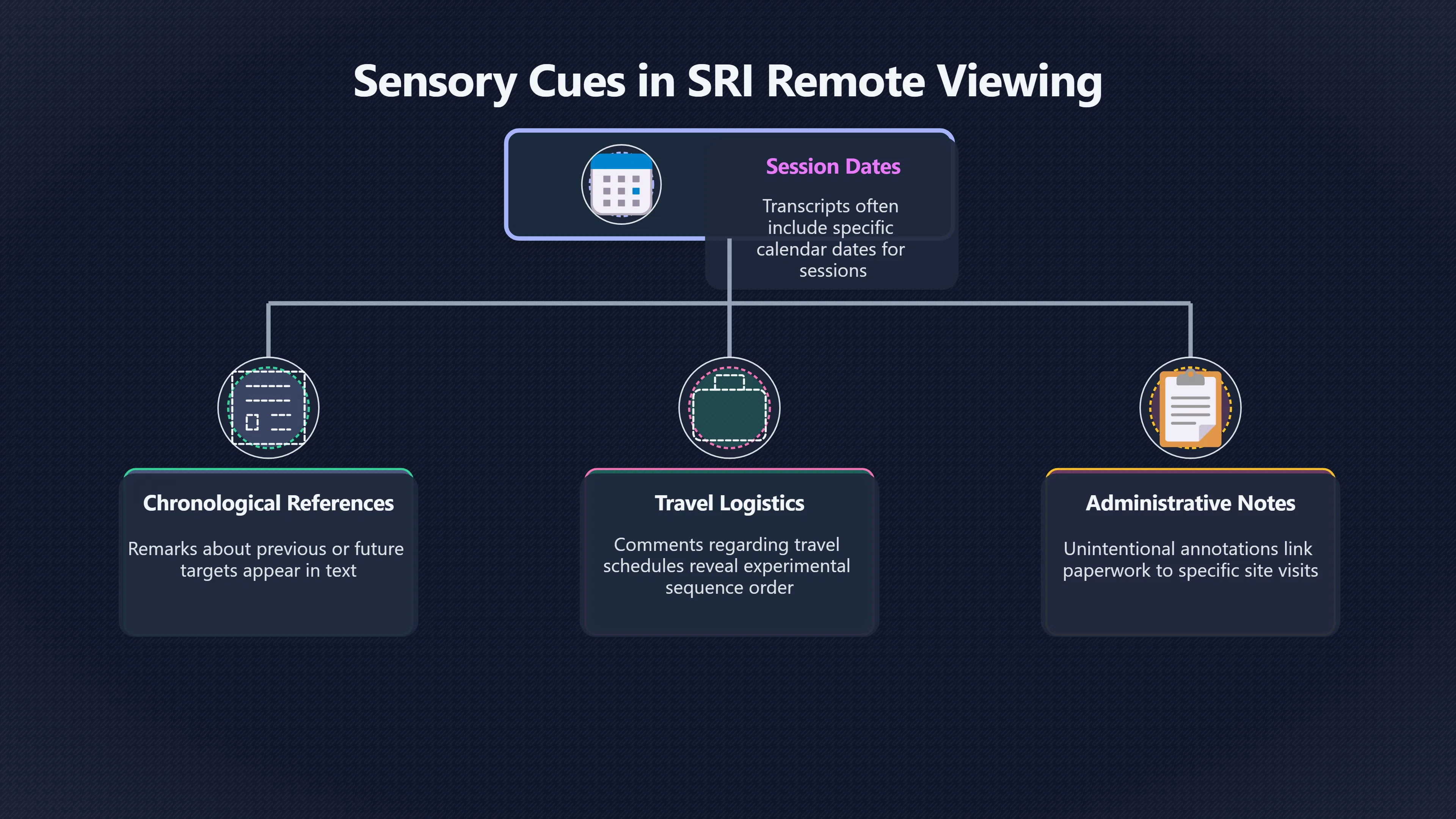
The critics pointed to several kinds of information that could help reconstruct the order of sessions without requiring any paranormal ability.
Examples included:
- Session dates written on transcripts.
- References to earlier or later sessions, such as remarks about “yesterday’s target” or previous experiments.
- Comments about travel or scheduling that revealed where the experiment fit within the overall sequence.
- Administrative annotations that unintentionally linked paperwork to the chronology of the target visits.
None of these clues directly named the target. Instead, they functioned like pieces of a puzzle. A judge who knew the order in which locations had been visited could use those fragments to narrow the possibilities dramatically. This was precisely the kind of “sensory cue” that Marks believed had not been adequately controlled.[PubMed]pubmed.ncbi.nlm.nih.govNature. 1981 Jul 9;292(5819):177. doi: 10.1038/292177a0. Author. D Marks. PMID: 7242682; DOI: 10.1038…Read more…
How order and dates could help matching
The importance of chronological clues becomes clearer when considering how the judging procedure worked.
Imagine that five target locations were visited over five consecutive days. If a transcript contains a date or an incidental remark indicating it was produced after the second session but before the fourth, the judge has already reduced the possible targets substantially before evaluating the descriptive content.
Even weaker clues could become useful when combined:
- a reference to an earlier target;
- notes suggesting the viewer was tired after several sessions;
- sequential numbering;
- document formatting unique to a particular day’s testing.
Each individual clue might appear trivial. Together, however, they could identify where a transcript belonged within the experimental series. Marks argued that once this happened, the remaining matching task no longer represented a blind test of remote viewing.[PubMed]pubmed.ncbi.nlm.nih.govNature. 1981 Jul 9;292(5819):177. doi: 10.1038/292177a0. Author. D Marks. PMID: 7242682; DOI: 10.1038…Read more…
This mechanism explains why the critique focused on judging materials rather than on the viewing sessions themselves. Even if viewers received no ordinary information about the targets, the evidence could still be compromised if judges later received unintended cues.
Why mundane clues mattered more than dramatic leaks
One reason the criticism proved influential is that it did not depend on alleging deception. Ordinary laboratory paperwork can easily preserve contextual information that researchers overlook because they already know the experimental sequence.
From a methodological perspective, subtle cueing is often more plausible than dramatic information leakage. A judge does not need explicit knowledge of the correct target. Instead, ordinary memory, pattern recognition and elimination can exploit seemingly harmless details embedded in transcripts.
This reflects a broader principle in experimental psychology: whenever subjective judgement forms part of the outcome measure, all irrelevant identifying information must be removed before evaluation. Otherwise, unconscious inference may influence decisions even when everyone involved acts honestly.[PubMed]pubmed.ncbi.nlm.nih.govNature. 1981 Jul 9;292(5819):177. doi: 10.1038/292177a0. Author. D Marks. PMID: 7242682; DOI: 10.1038…Read more…
The continuing dispute
Supporters of the SRI work disputed Marks and Kammann’s interpretation. Charles Tart reported that after editing transcripts to remove what he regarded as the relevant cues and having them judged again, performance remained above chance, arguing that the original findings could not be explained solely by paperwork clues. Harold Puthoff and Russell Targ likewise maintained that the critics had overstated the importance of the alleged cues.[SciSpace]scispace.cominformation transmission in remote viewing experiments 4jd6pdendvInformation transmission in remote viewing experiments13 Mar 1980 — He edited the transcripts carefully, removing all phrases sug…
Marks remained unconvinced. He argued in later exchanges that the editing had not removed every identifying feature and that the materials still contained enough contextual information to bias judging. The disagreement therefore shifted away from the existence of remote viewing itself and towards a narrower but scientifically crucial question: had every non-paranormal source of information actually been eliminated?[PubMed]pubmed.ncbi.nlm.nih.govNature. 1981 Jul 9;292(5819):177. doi: 10.1038/292177a0. Author. D Marks. PMID: 7242682; DOI: 10.1038…Read more…
Why the mechanism remains important
The transcript-cue criticism has had a lasting influence because it illustrates how apparently minor procedural details can affect experiments that rely on subjective matching. The issue is not whether any single date, comment or sequence marker inevitably determines the correct answer. Rather, it is that free-response judging is especially vulnerable to cumulative contextual hints.
As a result, later remote-viewing research placed greater emphasis on anonymised transcripts, randomised presentation order and stricter blind judging procedures. Regardless of one’s view on remote viewing itself, the debate over transcript cues remains a classic example of how careful control of paperwork and documentation can be as important as controlling the experimental conditions under which the original observations are made.[PubMed+2Nature]pubmed.ncbi.nlm.nih.govNature. 1981 Jul 9;292(5819):177. doi: 10.1038/292177a0. Author. D Marks. PMID: 7242682; DOI: 10.1038…Read more…

eBay marketplace picks
Marketplace Samples
Live-tested eBay searches with available results related to this page.



Endnotes
1.
Source: nature.com
Link:https://www.nature.com/articles/284191a0
Source snippet
Information transmission in remote viewing experimentsby CT TART · 1980 · Cited by 57 — [Sensory cues]({{ 'sensory-cues/' | relative_url }}) invalidate remote viewing experiment...
2.
Source: scispace.com
Title: information transmission in remote viewing experiments 4jd6pdendv
Link:https://scispace.com/pdf/information-transmission-in-remote-viewing-experiments-4jd6pdendv.pdf
Source snippet
Information transmission in remote viewing experiments13 Mar 1980 — He edited the transcripts carefully, removing all phrases sug...
3.
Source: scispace.com
Title: rebuttal of criticisms of remote viewing experiments 1j3arh0xxi
Link:https://scispace.com/pdf/rebuttal-of-criticisms-of-remote-viewing-experiments-1j3arh0xxi.pdf
Source snippet
Rebuttal of criticisms of remote viewing experiments23 Jul 1981 — Rebuttal of criticisms of remote viewing experiments. MARKS1 has argued...
4.
Source: pubmed.ncbi.nlm.nih.gov
Link:https://pubmed.ncbi.nlm.nih.gov/7242682/
Source snippet
Nature. 1981 Jul 9;292(5819):177. doi: 10.1038/292177a0. Author. D Marks. PMID: 7242682; DOI: 10.1038...Read more...
5.
Source: link.springer.com
Link:https://link.springer.com/article/10.1007/BF01961270
Source snippet
viewing | Cellular and Molecular Life Sciencesby C Scott · 1988 · Cited by 3 — Marks, D., Sensory cues invalidate remote viewing experiments...
6.
Source: Wikipedia
Title: Remote viewing
Link:https://en.wikipedia.org/wiki/Remote_viewing
Source snippet
Remote viewingTo find out if the unpublished transcripts contained cues, Marks and Kammann wrote to Targ and Puthoff requesting copies...
Additional References
7.
Source: cia.gov
Link:https://www.cia.gov/readingroom/docs/CIA-RDP96-00787R000200090017-5.pdf
Source snippet
INFORMATION TRANSMISSION IN REMOTE VIEWING...INFORMATION TRANSMISSION IN REMOTE VIEWING EXPERIMENTS: II. Marks and Kammann in a recent l...
8.
Source: researchgate.net
Title: 15839349 Information transmission in remote viewing experiments
Link:https://www.researchgate.net/publication/15839349_Information_transmission_in_remote_viewing_experiments
Source snippet
Information transmission in remote viewing experiments27 May 2016 — Rebuttal of criticisms of remote viewing experiments. August 1981 · N...
Published: May 2016
9.
Source: ui.adsabs.harvard.edu
Link:https://ui.adsabs.harvard.edu/abs/1981Natur.292..177M
Source snippet
cues invalidate remote viewing experiments - ADSSensory cues invalidate remote viewing experiments. Marks, David. Abstract. Publication...
10.
Source: youtube.com
Title: Scientific and Spiritual Implications of Psychic Abilities
Link:https://www.youtube.com/watch?v=zgyYms376Mg
Source snippet
Stanford Researcher Explains Why the CIA is Still Using Remote Viewing...
11.
Source: davidfmarks.net
Title: ‘That Dude’ Strikes Again
Link:https://davidfmarks.net/that-dude-strikes-again/
Source snippet
319 of Nature can be used to invalidate the [Pat Price]({{ 'pat-price/' | relative_url }}) series of remote viewing experiments...Read more...
12.
Source: youtube.com
Title: Stanford Researcher Explains Why the CIA is Still Using Remote Viewing
Link:https://www.youtube.com/watch?v=sqKczfi_PK8
Source snippet
Remote viewing, CIA psychic spies, and Project Stargate...
13.
Source: youtube.com
Title: Remote viewing, CIA psychic spies, and Project Stargate
Link:https://www.youtube.com/watch?v=dzsm8hMoIUg
Source snippet
Remote Viewing Explained: How the Mind Sees Without Eyes...
14.
Source: youtube.com
Title: Mind and Matter with Russell Targ
Link:https://www.youtube.com/watch?v=EhZ_ty3f4-M
Source snippet
Scientific and Spiritual Implications of Psychic Abilities - Russell Targ...
15.
Source: youtube.com
Title: Remote Viewing Explained: How the Mind Sees Without Eyes
Link:https://www.youtube.com/watch?v=whpZzUwrUNU
Topic Tree